

In this episode, Jon Summers and Mark Gammie delve into the storied career of Michael Schumacher, discussing his early start with Jordan, memorable moments in Formula One, and his dominant years with Benetton and Ferrari. They highlight Schumacher’s unparalleled speed, racecraft, strategic brilliance, and relentless focus. However, they also touch on controversial aspects of his career, such as instances of unsportsmanlike behavior. The hosts reflect on Schumacher’s legacy, his post-retirement return with Mercedes, and the impact of his life-changing skiing accident. They conclude with admiration for Schumacher’s resilience and contributions to motorsport.
Notes
Jon Summers is the Motoring Historian. He was a company car thrashing technology sales rep that turned into a fairly inept sports bike rider. On his show he gets together with various co-hosts to talk about new and old cars, driving, motorbikes, motor racing, motoring travel.
- “Michael is Worth Half a Second a Lap” M. Brundle
- First race at Spa
- Schumi vs. the other Sauber / Mercedes sportscar team members, Heinz-Harald Frentzen, Karl Wendlinger
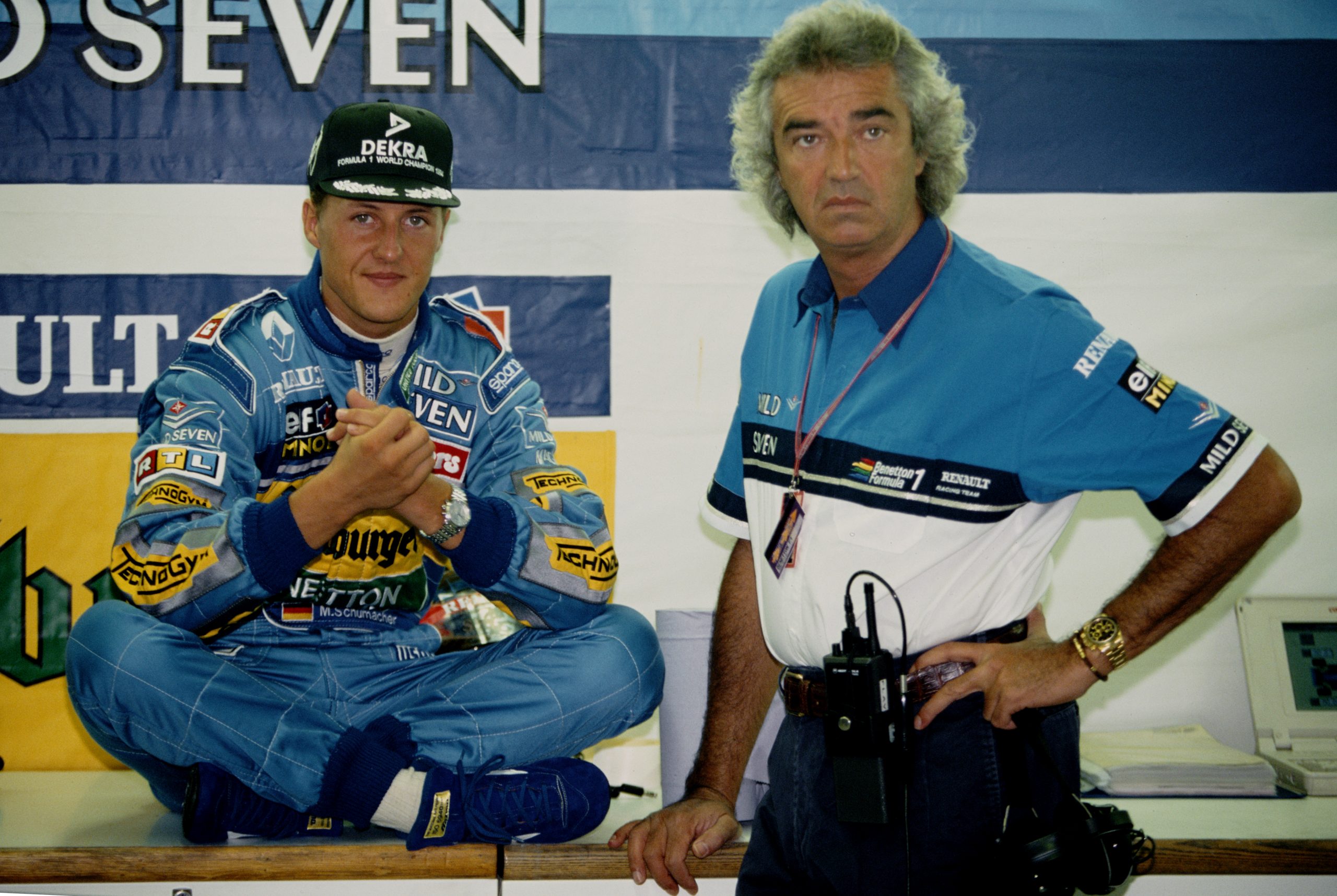
- Flavio Briatore, Michael’s team boss and the model for the Rueben character in the Brad Pitt F1 movie
- Senna, Schumacher, Red Bull, a line of unsportsmanlike winners
- Unlike Gentlemen like Damon Hill or Lewis Hamilton
- “You probably win 20% more championships by being an arsehole”
- Schumi vs. Hill
- Schumi vs. Senna
- J’s article on how Benetton and Schumacher were cheating in 1994, setting Senna up for Imola
- Early championships for Benetton
- Make Ferrari Great Again – many great drivers try, few succeed
- A few great races dissected
- Schumi vs. Jean Alesi
- The flywheel effect of Michael’s speed
- Ross Brawn and the stint-based strategy, enabled by Michael’s speed
- Raw speed, but an ability to maximize variable factors like new circuits or rain
- The low moment of Monaco qualifying in 05/06
- The ability to strategize while lapping fast
- J’s memories of Jos Verstappen before Max
- Schumi vs. Max Verstappen
- How a father can help a son in motor sport
- Michael, Ross Brawn, Rory Byrne and Making Ferrari Great Again
- Paul Baxa and Facism in Motor Racing
- Parallels with other great motor racing dynasties of the early 21st century – Sebastien Loeb, Valentino Rossi, Jimmie Johnson – was this a result of increasing aero?
- Schumi’s broken leg at Silverstone, followed by an very impressive comeback in Malaysia
- Bridgestone tires developed specifically for Michael, for those weather conditions on that track
- A sum up of Michael’s peerless skills at the end of his Ferrari career
- The Prisoner of Zenda
- The Mercedes years
- The ski-ing accident
- Lucky early in his career; so unlucky afterwardsHas anyone apart from Lauda come out of retirement successfully?
- The greatness IS compromised by the ruthlessness, because that made him willing to be unsporting
- Schumi vs. Mika Hakkinnen and JP Montoya
- Schumi, Triumph sportsbikes and a stumbling return to F1 with Mercedes
- Schumi vs. Martin Brundle – terrible F1 career but great life
- A Disney movie-esque ending; not dead, but not with us either
- If anyone can come back from where he it now; Michael is that man
- “For a long time, he was peerless”
Transcript
Crew Chief Brad: [00:00:00] John Summers is the motoring historian. He was a company car thrashing technology sales rep that turned into a fairly inept sports bike rider hailing from California. He collects cars and bikes built with plenty of cheap and fast and not much reliable. On his show, he gets together with various co-hosts to talk about new and old cars driving motorbikes, motor racing, and motoring travel.
Jon Summers: Good day. Good morning, good afternoon. It is John Summers the Motoring historian with Mark Gamy. Good evening tonight, Michael Schumacher. The greatness of Michael Schumacher. Mark, why are we, how are we qualified to talk about the greatness of Michael Schumacher? Because we watched most of his races on the couch together.
We may have even dozed off and [00:01:00] may have been alcohol. It’s possible involved. Who knows? There may have even been other intoxicants involved at different times in Michael Schumacher’s career, but we watched. Michael Schumacher’s career. Did we not? We watched the qualifying. We begrudgingly acknowledged that as Martin Bruell said, Michael is worth half a second A lap.
Mark Gammie: Yeah, we watched all of it pretty much, didn’t
Jon Summers: he? So what’s the earliest memory of Michael?
Mark Gammie: What the earliest memory for Michael is when he got that substitute drive at Jordan in Spa? The Green seven up car? Yeah. When he first came across. What do, what do you remember? What do you remember about that drive?
’cause that’s my earliest, I don’t remember anything about the drive, if I’m honest. I remember him qualifying it in seventh or whatever it was, and thinking
Jon Summers: that’s it. He qualified, like, I don’t know whether it was sixth or seventh, the Google sphere will deal with that. He qualified blindingly well and then blew the clutch up on the line and had a, I can’t even remember if he did the race or if he retired right there on the ride.
The point was he [00:02:00] was
Mark Gammie: faster than Doche is as a substitute. It’s not surprising looking back now, but at the time people were like, oh.
Jon Summers: Oh, where he qualified on the grid was completely out of place. I was blown away by how fast he was. I was saying my earliest memory of him is reading about him when he was part of the Mercedes, like sports car team.
Like group C team when he was driving for Salba. I dunno if they were salba then or if they were Mercedes, but do you remember there was schumi. Heinz, Harold Freon, who made it all the way to Formula One and who people don’t talk about now, but we’re actually at a reasonable formula One career, one race for Williams was in contention for a championship.
Was reasonable at Jordan. Wasn’t he old? Mm-hmm. HH Freon and the other one. One I
Mark Gammie: spoke as well by cancer.
Jon Summers: Yeah. Well, Michael stole his girlfriend, didn’t he? That his wife was dating Frankon before she was with Michael Carina. Is it? I don’t even know her name. No idea. And the other one was Inger [00:03:00] Carl Inger.
You remember what happened to him? End of the tunnel. Out of the tunnel at Monaco into the end of the barrier. Weekend after center. It was the race meeting after center. Inger hit the end of the, you know that where Brundle had that terrible accident there not Brundle button. It’s where if you’ve seen the movie Grand Prix, it’s where the accident is there, like the Chicane.
And Bandini had his moment there as well, didn’t he? That was the moment that that was where Ven Leer went. Yeah. So from my earliest memory of Michael and when Michael separated himself from those other three was in that seven up Jordan at spa. And you know what a place to do it.
Mark Gammie: Yeah, I mean, he was just dynamic straight arriving, wasn’t he?
Obviously people remember him for the time of Ferrari where most of the championships came, but obviously two of the championships didn’t come from there. They came from the Benton time, which again, if you like, classic Formula One for me in the, it’s the [00:04:00] era of full on team is the way of sort of, you know.
People tracking down radios that were set to transmit on their frequency, taped up in the canteen so that they can’t get a radio broadcast to their cars during the race. You know, all sorts of stuff like that. Obviously your main man at Benetton who had, uh, should we say. His card marked on several occasions for some creative
Jon Summers: interpretations of rules.
So let’s just touch on that, right? Because this modern Formula one movie, the team manager in it, his name is Reuben, but he is basically Flavio Bri tore, with the exception of the Lewis Hamilton characters manager. He’s the best character in the movie. Well, I know the villain is really good as well, but I feel like it’s easy for the villain to be good in that movie.
No, the, the Ruben character is Flavio Bridge, or it’s this flamboyant, really well dressed, Mediterranean handsome kind of team manager. Yeah, and he [00:05:00] was looking back, his ruthlessness matched Michael’s. Ruthlessness, isn’t it? Yeah.
Mark Gammie: They were a, a devastating partnership.
Jon Summers: And the cheating. Right? And the cheating.
Now guys, listeners, is well worth looking back on because it’s like cheating, but with like 32 bit Windows, 95 kind of computers, it’s really, really, really like they cheated with traction control and you could hear it, you could hear it go away from the line, but away from corners. But people still didn’t quite cop onto it.
But we’ll move on to that because what I wanna touch on Mark is do you have any recollections of that brief period where we did actually have Senner versus Schumacher? Do you have any memories of that period at all?
Mark Gammie: Not massively. I mean, because Sena for me, I, I respected Senner. I mean, how could you not?
But for me, his whole sort of, you know, touched by Godness. Sort of slightly sort of religiosity in his, uh, fluff, should we [00:06:00] say. Didn’t quite sit with me having arrived sort of after, at F1, sort of after the season where it ended with him just smashing prossed off at the first quarter. And me thinking that’s kind of cheaty.
It’s not really very sporting, is it?
Jon Summers: No. Well, I mean, no, but like, you know, ified or not for the sati out there, justified or not. And, and you know, I loved Sena, but yeah, it was out of order. And this is important because sinners out of ordinance open the door to Michael’s out of ordinance, in my humble opinion.
Mark Gammie: Yeah, completely. And opened the, the, you know, the door to the current red ball out of ordinance, if you will. And you know, the, the recent history. The last 10 plus years certainly of Red Bulls created bullshit. If you ask me again, not as someone who follows it closely these days, but the same ruthless driver, the same ruthless team, the same disregard of actual facts for what they would prefer you to have seen.
You can trace the line all the way back, [00:07:00] but it doesn’t have to be that way. And I think you can look at people like. Damon Hill and Louis Hamilton and a lot of drivers that don’t do it that way, but are gentlemen. Yes. I, I quite agree. Yeah. You could absolutely also probably point, I bet you could do a spearman rank kind of distribution on those of that shit and show that you probably win if, if I had to guess about 20% more championships if you’re an asshole.
Jon Summers: Yes. Yes. Well, and, and definitely, you know, they always said about Ruben’s Bar that he was never nasty enough to be, uh, a really winning racing driver. And I, and I feel like there has to be part of you that is ready to do a really dirty move when it has to be. Done, which makes Damon Hill all the more awesome, by the way.
Yeah. I think in period, I didn’t realize how awesome he was, and nowadays people don’t talk about him. Everyone’s like, oh, Hackerman versus Schumacher, because everyone just thinks that the Williams was the best car, but no. Right. No. For some of that period, certainly with the Arrows, I feel like Hill was [00:08:00] really worthwhile.
Mark Gammie: You don’t get championships for free. The championships, even back then, like, and obviously they’re so bloated now with like 20 something races, but even then there were more races than there were back in the seventies and you know, certainly in the sixties. But you know, you have to be consistently good even in the best car.
And I think you did have the best car. You don’t win championships without being bloody good.
Jon Summers: So my recollection. Of the combat versus center is that they had a little bit of contact, but there was never any like wheel to wheel great battling or, or any like, anything like that. And I have a piece, I’ll put a link into it, but fundamentally it is clear that Benton were cheating for those early races of the 1994 season.
They were cheating in two ways in the, with the traction control, and this was my understanding is as a software program that when you turn the motor off, the chip forgets the program. That’s part one. And part two was the, do you remember [00:09:00] it was the beginning of refueling and the refueling rigs. They were standard issue from the FIA and they delivered fewer at like 10 liters a second, or I can’t remember the stitches either way.
They were like, add like a double seal on them and obviously you weren’t meant to tamper with them. Well, my understanding is, is that Benetton tampered with them and so they flowed faster and that would explain why in a couple of races. But I think definitely the aida, the Pacific Grand Prix round, that’s why Schumacher was able to leap center in the picks.
Flas cheating, delivered a Michael skill. In fairness, put Sena. Oh yeah. In that position at Mila where he really felt like he had to win. He really felt like he absolutely had to win that weekend in, in Mila and Michael, features in the Sini series, but not really. He’s just like in the background. The sense of the pressure building up comes like not from Michael.
It came from Michael in period. In my humble opinion. Now [00:10:00] I’m gonna say we talked about Hill there. I don’t have a lot of recollections of Michael’s early championships, those ones for Bennington, and that’s because when Santa died, I just sort of stopped. Watching and I would say you will remember the moment where I sort of reconnected with it.
It was when we were in the states, when we were here for the first time. And when we arranged to meet in Chicago bus station, didn’t we? And for a hot minute there, it looked like I maybe wasn’t gonna show up. And you were maybe gonna be stranded in the middle of America with no money. You had like $80 or something, didn’t you?
And more down to your last. $10 and I just bought a burger.
Mark Gammie: I I had six bucks left when I arrived at Chicago Bus Station. I think you were two hours, 40 minutes late by confidence, you turn up eventually.
Jon Summers: I, I was, I was, I did turn up eventually and in fact, whilst I don’t know why we meet, but anyway, I remember I did whilst walking a lap of the bus station waiting for you, I saw a piece of paper, like newspaper blowing down the [00:11:00] street and it talked about Schumacher.
Being champion like for the first time or the second time. I can’t even remember which it was, but it talked about him being champion and I was like, oh wow. ’cause I did actually watched that race in Adelaide. You know, the one where he got Underhill in a example of his dirty driving. But we’re gonna talk about the greatness assuming, and then we’re gonna talk about the dirty driving stuff at the end.
Cool. I feel like. My first recollection of watching him race with you and us grudgingly admitting that although he was a little bit robotic and he didn’t have the passion that we’d seen from like a center or a mansel, was that time with Ferrari. ’cause he won those couple of championships for Bennington and then he was like, you know what?
I am gonna. You know, as Luca Di Montelo says, when I joined Ferrari, she was like a great actress who was getting no scripts. This is when I saw him speak at the Stanford Business School bloody 20 years ago now. But he was like, I wanted to like bring her back. You know that, well, that’s what Michael wanted to do.
That’s what Alonso wanted to do. That’s what Vela wanted [00:12:00] to do. That’s what Hamilton wanted. Well, Michael managed it. Didn’t he? Yeah, a year in 97. I remember it was a bit like watching Senna in the early years where if the circuit was an asshole circuit or if it rained or if they’d never been there, but it was some wild factor that meant it was pure driving skill.
Michael would probably win, but the rest of the time he was like qualifying in the top five there and thereabouts. But do you have memories of that
Mark Gammie: period? Yeah, because when he arrived, the car wasn’t good enough, was it? I mean, the car was pretty poor that first year. As you say, if it rained or there was something going on, he would stand out to you and you’d be like, okay.
So I mean, I’ve got a few like just jotted down. I did a quick deco through the careers to races that stood out for me. Obviously the first one, Spain 94 stuck in fifth gear for most of the race and finished his second, not any other gears, fifth gear the whole way round the circuit. And you second, I think you lost less than a second or that pretty decent.
That was an impressive thing.
Jon Summers: Yeah. And similar to that [00:13:00] incredible drive of CNAs at Rio, where the car’s like stuck in gear.
Mark Gammie: Exactly. 95, the European Grand Prix, that’s the three stopper. If I record Oh, no, no, that’s the, the, that is one of the three stoppers, so that’s not the three stopper. So three stops.
European GP takes 25 seconds out of a Lacey in 15 laps and then passes him around the outside of the. Okay. I mean, that’s grabbing my attention. I mean, because of course that’s one of those really exciting periods where they’re like, checking the seconds all the time. Now that’s another half second, you know?
Oh, that’s a, that’s 0.9 of a second. You’re thinking, Jesus, what track was that at? It’s the European Grand Prix, like in 95. Let me just have a quick look. It probably would’ve been
Jon Summers: nerve burging, wouldn’t it? The lifer.
Mark Gammie: It was, yeah, nerve burging.
Jon Summers: We’ve flipped back to his Benniton years there. Haven’t, what you’ve correctly highlighted there is just how dominant he was.
A benniton that really, he had done it all by the end of his two years there, so he was like, oh, I’ll go to Ferrari. Even though he was [00:14:00] only like 25 or something at the time when he went there. And I’m a Ferrari fan. Through those
Mark Gammie: years, I’ve been supporting Lacey, looking out to see where Burger was coming in those, the 27 and the 28 cars, you know?
And I like the guys. Yeah, Lacey was cool, you know, and he’s cool. Yeah, you see him interviewed. Lacey is a cool guy. I mean, he’s about two for three, but like, you know, he’s a cool guy. And he was quick. You’d look for what he would do, the little laci nest. Would there be a burst? Would there be a sitin on a, a set of tires that he really liked in the race or something?
And, you know, he’d put in a, a spurt and he’d do a good race. But Michael delivered that every weekend, not just a little bit here and there. Sometimes if you watch the whole race qualifying and the race, there would be something. Where you were like, ha, diggity, that was something, you know, there would always be something
Jon Summers: to me, it’s like the difference between an alpha and A BMW that you wanted to like the alpha more, and sure there were some things about it that were better, but you just knew that on the rainy morning on the auto barn where you just is thrashing with rain and is that a idea that I need to break and steer?
You [00:15:00] just want the BMW in those moments. And Michael had that kind of just relent you. This is what built the team. And this is what I’ve got next to Ferrari is I’ve got Ross Braun and Rory Byrne written down. But the point is that if you are part of that team, if you lean in to Michael, what you get, he always delivers.
Well, absolutely. His speed built the team, his speed, his Roboticness built team for
Mark Gammie: sure. Dude. I mean like, so the other races I’ve got in that period, so Fain 96. His Reagan meister sort of first getting on the Glos. I think that was the first Ferrari. Ferrari win. He wins by like, he’s like 45 seconds ahead, you know?
Not a bit ahead. Mild. So which racks was that? Spain 96. Sure.
Jon Summers: Was it
Mark Gammie: at Barcelona then, or, uh, I think it was Barona, Hungary 98. That was the one where it was to beat Hackerman. They needed to three stop. And it wasn’t just a three stop. Ross Braun’s, like Michael, you we’re gonna give you new sets of tires, we’ll get you in when we can in [00:16:00] clear air.
It needs qualifying laps, all qualifying laps. And he was just mucking metronomic, just like within a tense or two of qualifying pace
Jon Summers: all the fucking time. Let’s stop and think about that because I was saying this to Wally the other day that this whole way, that modern formula one is where you know it stints and you have to like that whole way of racing was invented.
By Michael and Ross Braun. That Ross Braun visualized the strategy based upon Michael’s speed. And as you just said, Michael just delivered with the speed. It was really, and, and this was the thing with it, the, as a, as an Englishman and as somebody who loved the sport, you know, I, you instinctively wanted to.
Bought Damon Hill in those years, and by the time he’d left Bennington was at Ferrari. You instinctively didn’t wanna support him because you knew how dirty he was and he didn’t have the sort of, but it’s from my heart kind of passion that I saw in center, and he didn’t have that for me. He was just. Did whatever was best for the team.
Mark Gammie: The way I see Michael, and again, [00:17:00] I don’t know him, I, I just watched him a lot and I watched the interviews and as I say, sort of spent the whole time immersed in F1. At the time, there was no quarter, it was all in. If I’m in for this, I’m all in for this 11 tenths. Yeah. I’m like, I will pull any rug from anyone.
I will do anything to get the fastest car. I will, don’t get me wrong on the track, I will be peerless, you know, I will be the fastest thing out there. And don’t worry about it. If it rains, I’ll give you faster than everyone else. Even more. Then if there’s an alternate thing, something chucked into the mix that will, you know, shake it all up, I’ll max that as well.
Jon Summers: Tom Brady and the cheekiness with the ball. It so reminded me of Michael. It was like, really, you really had to do that. You really had to. I just wanna highlight, we’re gonna talk about this a little bit afterwards, but the thing that really stood out for me with Micah was, do you remember when I, right at the end of.
Michael’s time where Alonso was coming on really strong and they changed the rules basically just to defeat Michael. And it [00:18:00] was Monaco qualifying, you know, I’m gonna say this, you knew I was gonna say this was qualifying at Monaco where everyone knows qualifying is the most important thing. And there was a format at the time where you had to like go out and do a FS lab and there was only a tiny window and Alonso had been fastest all weekend and was gonna go out and do a FS lab.
And what does Michael do? Parks it against the barrier at he,
Mark Gammie: he, he outbreak himself crashed. So
Jon Summers: just so cynical and so obvious and coming on the back of the other things that he’d done in his career. It was just, oh, it embarrassed you
Mark Gammie: as a Ferrari fan, I wanted the guy, I went, you know, you’re like.
Ferrari fan, you know, you’ve suffered through all the years of the being rubbish and now your team’s good and it’s winning all the time. And you’re like, this is fine. You know, I’m happy to see pole and, and then the win each race, people are getting a bit bored of it after four and a half, five years. I understand.
I was bored of losing, you know? So it’s the way these things come and go. But yeah, it would, it was just one of those ones you’re like, oh, for fuck sake, you know, I, you try and hide in your [00:19:00] face as a fan, being like, oh, really? We have to do this. You know, they, before they demoted him, they had the post qualifying interview.
He looked like the cat that’s sitting there caught in the cream all over his face going like, uh, me like. What as to say. Yeah,
Jon Summers: because he planned it.
Mark Gammie: Of course he had, I mean he was absolutely a blatant cheat alonzo’s out behind him three seconds through the threat. It wasn’t
Jon Summers: like he went out and, you know, the idea came to him, oh, I could just do this.
And it wasn’t like spontaneous. Oh, I dunno. I, I’m
Mark Gammie: not sure about that. I think maybe, I think he would’ve gone out expecting to be faster or hoping to be, but if he wasn’t on hard way round, I’m thinking, he’s thinking, how do I part this in the barrier? Because that way I can, I think by, I think he, he’s quick enough to process that in the lap.
Jon Summers: And that’s a good point. That was the other thing about him, wasn’t he? He, that he was very quick. Mm-hmm. At processing stuff in the race. And again, now we expect people to be able to do that. But he was the first driver who actually did that. Remember they called Prost LA [00:20:00] professor. ’cause he could actually work out his fuel stint without the team needing to radio it to him.
I mean, now if Pross was the professor, you know, Alonso is. You know, Stephen Bloody hawking in comparison. Right. And And I dare say Vishen, is that more so this is what I was gonna say. We were talking about the cheaty fuel rigs. You remember what happened with those cheaty, fuel rigs, Schumacher’s teammates, car caught fire.
Do you remember who that was driving that car? Joss Vapper. Oh, of course. Yeah, yeah, yeah. My own memories of Joss v. Prior to the sun were that pit lane fire, which proved the Cheaty fuel rig. Yeah. And he, he had a huge crash at the beginning of Rio, and I thought, you’re a fucking idiot. And now, more recently, I’m like, you are a fucking idiot.
I didn’t like Christian Horner, but I really feel sufficiently passionately about I actually have time for [00:21:00] Max. I actually have time because I’ve, you can’t talent, you can’t deny talent. It’s like he’s Harry Line,
Mark Gammie: Michael. He will do anything to win. He’s very like Michael, he just, he’s very like Michael.
He’s intentionally fast in all circumstances, like, you know, he’s just ruthless
Jon Summers: and yos is steamrolling it for him. I am doing gas carting with my boy. If you look on the website, it says the boy has to be 13, my boy’s 11 and he is doing it. Now, why is that? Well, the bloke that runs it is English. We’ve gone out, we’ve done the tests.
It’s clear that my boy knows how to drive around the track not getting in the adult’s way. When the adults come up and pass him, he moves off the racing line and waves them through and they give him a nice wave and, and go on by. He’s a pleasure to be out on the track with, so why wouldn’t a bloat running the series?
Take my money? My kid knows how to do it. What that means is that by the time he’s 15. And in the middle of the series, he’s kind of before years experience. That’s how you, so when you think about, we’re [00:22:00] talking about the greatness of Michael Schumacher and it’s really awesome that you said that Max reminds you.
’cause Max does remind, and I think it’s thanks to Yos. I think Yos this line that we just talked from Sena through Michael to Red Bull now.
Mark Gammie: Yeah, if I do it, it’s not cheating. So that’s the mo That’s pretty much how it is. I’ve gotta say, look, shout out Orlando Norris. Congratulations. I think he’s a genuinely nice bloke and he’s won the championship.
And that’s also, yeah, I was
Jon Summers: kind of more of a pastry man myself, but I, I don’t watch a race. Hey,
Mark Gammie: whatever. I wouldn’t have minded if he’d, if pastry had won either, you know? Um, it’s a. To the big, to the spoils, et cetera. I don’t have a horse in this race, but congrats. He seemed like a nice chap and it’s nice to see that that sort of rewarded.
So,
Jon Summers: so let’s break down Michael’s time at Ferrari, right? Because he went there in 97 and the car was crap. The car was good by like 98 on 99. Thanks to this dream team and this flywheel effect of Michael [00:23:00] Ross Braun and Rory Byrne doing the engine. So that’s two Englishmen. Like as English as you or I two Englishmen and a German making Ferrari greater game,
Mark Gammie: I think.
I think Enzo would’ve approved, wouldn’t he? I mean, he didn’t really give that much of a shit about that either,
Jon Summers: did he? Well, he always preferred not having the Italians because before the war with the fascists, if you drivers died, they were like compared to Saints and it was fine. Paul Baxter, Google up this guy, he’s written some.
Really interesting stuff about fascism and speed and sacrifice and the whole stuff. It’s really, really awesome. After the war, it it, it was no longer cool for people to be killed in motorsport, so Ferrari was like, I. Didn’t really want Italian drivers. He liked foreigners because the Italian press got less upset if it wasn’t, you know, the son of Lodi being killed.
If it was like E beyond being ggl, it didn’t really matter so much. Yeah, that would of course be [00:24:00] my Hawthorne oh two and oh four. Those were the years that Michael was completely dominant and made the racing completely boring. I can’t remember what happened in oh three. This is Post Hacker, and see that era where Hackerman sort of took him on a little bit.
There was an era for a hot minute there. Montia was sort of in the picture as well, but there was very definitely a stat ranking of 1, 2, 3. Between them and with hindsight. The racing was not as close as it had been in the years of the Big four of like center, pk, prossed, MANSEL. They were closely matched with different skills.
It didn’t seem that way to me in the Michael era. Now, I should say. Michael Dominance at Ferrari. Nowadays, this is typical, right? Since then, we’ve had vets dominance. We’ve got, which happens now. We add Louis Hamilton’s for a little bit. It has become typical, and I think it’s interesting because contemporary with Michael, there was Jimmy Johnson in nascar.
[00:25:00] Arguably Rossi in bikes, but I think less so, but even more than Humie, Sebastian Loeb in rallying. So I feel like something happened with technology. There was a critical mass with automotive technology that meant that. Even though the cars at the back of the field were like closer. So in theory it was more competitive ’cause the cars at the back were closer.
In actual fact, you know, the gap between Manchester United and Charlton Athletic became a whole lot wider. So we’ve come somebody like Loeb or Jimmy Johnson with, you know, with Johnson, it was, was. Chad Kau, is that the, gosh, NASCAR guys will hate me, but I think that was the name of his, like Ross Braun that created the same kind of flywheel effect, you know?
’cause they were the best team or the best mechanics wanted to join ’cause they had the best mechanics. Their pit stops are faster ’cause their pit stops are faster. Jimmy Johnson didn’t need to overdrive the car, so at the end of the race his car wasn’t smashed up so he could drive through and win kind of thing.
You know that it, there was that same kind of, and I feel like there was something [00:26:00] in Motorsport at that period. At the turn of the century, which you still have now, that means that the technology just meant that a small technological gain, you could flywheel out into a really, uh, big thing. And I feel like Michael and Michael’s dominance at Ferrari is symbolic of that.
Mark Gammie: Yeah, and I’ve just thought actually it also sort of coincides with really extreme downforce, doesn’t it? And it’s ing up of the air and the cars behind and therefore running close to people and being able to pass become more difficult. So I guess that would feed into the same thing. ’cause if you are got track position, you know, it’s, it’s hard to overtake.
So those sort of things have been. I think for quite some time, but they’ve got even worse lately. It’s still a modern problem in F1, not being able to follow through, not exclusive to F1. MO GP has that now since the sort of extreme arrow. You have that phantom stuff where you’re hard on the brakes at the end of the know Maje straight at 225 miles an hour.
You get into the slipstream with the bike in front and your bike accelerates, you are [00:27:00] on full break, the front’s bottomed out and then it starts accelerating again as you’re heading towards the gravel trap. So this not being able to follow things due to Arrow is not just
Jon Summers: F1. I mean it was 75 years of Formula One at heavily this year, right?
So you’ve a row of like four wheel one cars, and as you walk along them with your 11-year-old son, he looks at the McLaren four four, the 1988 Centene car. It was actually the. Pross car ’cause that’s a better example. Pross had a very original like undamaged car that he raced most of the season. So that was the car that Mc Clara had at Pebble, I think quite rightly.
Hmm. Very aerodynamically clean in comparison to even the cars of like the turn of the century. The Schumacher Ferraris and those cars are so much more aerodynamically simple than the V 10 stuff of the Vel kind of. Era. Yeah, so I think you are right. I think the big downforce is part of that. And just arrow generally being more of the thing.[00:28:00]
I mean, just
Mark Gammie: a couple of other races, uh, just to mention, I guess, Malaysia 99. I remember that was the year, didn’t he break his leg at cops? Atto was
Jon Summers: Silverstone,
Mark Gammie: so I dunno
Jon Summers: what happened for him to slide on into the barriers. But yes, younguns at Silverstone, it was like, I mean it’s 200 miles an hour hangar, isn’t it?
You break and turn in, I don’t know what speed they would go round it then, but probably, certainly more than a hundred miles an hour, probably more than 150 miles an hour. And he speared straight off into the barrels, broke his leg, didn’t he? It looked like he would be out for a while and
Mark Gammie: Well he, I mean, he was.
But I mean a couple of months I guess. I mean, what was, he was back in Malaysia, which was back end of the season, Malaysia round every year, wasn’t it? But the buzz about it at the time was, of course, is he gonna have lost any speed first major accident? Plenty of people have, have big ones and the same, you know, and not.
You know, just lose a couple of tens. Nothing, you know, still epically fast, still faster than you and I’ll ever dreamed to be, but they’re not quite [00:29:00] maxing it. Net net, that was total bullshit. He came back and out qualified everybody, including his teammate by over a second, like everyone. I mean, one second isn’t happen nowadays and didn’t happen then.
So, you know, put that to bed pretty quickly. And he spent the rest of that year doing everything he could to lose races to Eddie Irvine to try and ensure Eddie Irvine won the championship unsuccessfully, as I recollect, because Eddie Irvine’s never been won a championship, but I remember my, uh, I think Martin Brule saying after one of the races, well, Michael’s done everything he can to lose this race and still won it because he couldn’t be, he drives slow enough to hand it to Ed Irvine because of the traffic.
Irvine was stuck in. That was how the end rest of that year worked out. Is it 2000 to 2005? The years of the, the sort of back to back championships? It was omic.
Jon Summers: The two I’ve highlighted are 2002 and 2004 because I think those ones, there was virtually no competition. And I think after that, and certainly that was the era where by that time I don’t think you and I were, were watching together quite as [00:30:00] much.
But the people I was watching with. Definitely lost interest at this Michael Processional kind of thing, which interestingly has become a feature since then that you know even more than it used to be. You used to be able to take a guess that it would be one of two or three drivers, whereas now I feel like the sports evolved to a stage where you’re like hoping it isn’t gonna be a particular individual unless you’re a supporter of that individual.
It’s a really strange,
Mark Gammie: absolutely. I mean, it was just every weekend. Dominance. But uh, yeah, you’re right. They did. I can’t remember what the rules changes were, but they changed them up to be more,
Jon Summers: yeah, it was to do with, because that was the, the, do you remember that was the time, the development
Mark Gammie: time and all that sort of wind tunnel time and all that sort of stuff.
They started to limit,
Jon Summers: well, no, I think that was in 2008 that they did that. What I remember them doing with Michael was, do you remember that, that that was when Mitchell and were coming into the sport mm-hmm. And Bridgestone were only supplying a small number of teams. Oh yeah. And then reached a point where they were only supplying like.
Ferrari and two [00:31:00] of the back market teams, they were basically just developing tires for Michael, and it was the time where you could have compounds on the fly. So Michael could like go out, do the warmup, go out, do Friday qualy, or do Friday practice or whatever warmup, and then for Qualy on Saturday could have like a bespoke set of tires made up for those weather conditions and, and that.
So it was that kind of thing. I think that they, and just for
Mark Gammie: anybody that gets upset about like us sar casting aspersions at anyone for cheating, that’s why I started off by saying cheating as the, the, the golden era of cheating. And it carries on. It wasn’t that long ago where you remember they used to have that sort of automatic delay after the start, before the red lights go out and they can all go and it would be a varying amount of time between like one and four seconds of delay between it, the lights all being on and then going off.
Yeah. Um, I, I read an article the other day, I can’t remember which year it was. Teams had got wind of something in the signal that they wouldn’t change the delay from the practice start to the main start, and teams worked out how to hack it. [00:32:00] So they were just programming in like a N point, one second reaction time for their drivers and then just sending them to go immediately when they knew it was gonna go off.
And the reason the FIA caught ’em. They left it on one weekend and didn’t send the setting, they delayed the start about another two seconds and like nine drivers jumped the start.
It’s like, ma, well we don’t have to look too hard to see who the cheats are, do we? So, you know, this is not a sort of, they were just took it to another level. And I thought, I, I would go surprised to say that sort of those sort of things are, again, it’s a ruthless. Billion dollar sport where the money from, the advertising, the power, the intoxication, the flamboyance, the supermodels, the casinos, you know, the absolute up its own arse ness.
So thing of it must be incredibly intoxicating. What a massive high you are gonna be absolutely full of yourself. You know, you are king dingling if you are, uh, you know, [00:33:00] in that position. So it’s not surprising that people will do anything to win. You know, no one gives a shit who game second and when that much money is being spent, you know, they limited the spend to something like, was it 250 million or something?
Which still doesn’t sound like a lot, but they, there’s a one to run two cars for like 25 races. That’s a shit ton of money. And that’s limited, you know, and that doesn’t include. Quite a lot of sunk costs that they can add to it. So there’s
Jon Summers: a lot
Mark Gammie: of stake.
Jon Summers: So they changed the rules to defeat him and in 2005, Alonso as the first of his championships, and then I think another in 2006.
So I wanna kind of draw a line under that. Early period of Michael’s career and, and I wanna highlight, I think, key strengths that people should take away, right? The first is that sheer speed brundle and the half a second el lap. And the fact that that worked all sorts of different ways. ’cause it was like free horsepower.
You could like add downforce, you could do a different fit strategy. It just opened [00:34:00] so many doors. The strategy, which is sort of bolted onto that, that has become a feature of the sport now, is that you use pit stop strategy to give you an advantage or you hold a teammate back by pitting late or something like that for all the speed.
Michael wasn’t like Vel was where he had the speed, but if like, you know, if a sheep farted that morning or if he didn’t have his breakfast, just the way he liked it, he couldn’t do, Michael wasn’t like that. Michael could tiger. Not always, but Michael could tiger from the back when he needed to. And he was great when conditions were uncertain.
He was awesome, not just in the rain. The other thing he was, uh, really good at was he learned the circuit really, really fast. And another Brundle story that I always remember about him was talking about how Brun had been a Barcelona or Silverstone, but either way, he’d been there for like a day and a half.
With the team testing, Michael flies in. ’cause Bru and Michael were teammates at Bennington, weren’t they? I [00:35:00] think in 19, anyway, Michael flies in and his second lap out is faster than anything Martin has done so far this weekend and you’re just like, oh. Because the psychological effect of that was huge, right?
The It could not be. The focus on me, we’ve just talked about. So speed strategy, racecraft, the focus on me, this is what made him stand out. But also I’ve got him here as the classic German baddie that was the head in that, that I gave. And you know that movie that we’ve enjoyed. We’ve enjoyed the novel as well, the prisoner of Zender.
James Mason, who’s as English or as American as they come, is the German villain. And do you remember right at the end he’s acting like he acts like a gentleman, but then right at the end he turns into a dirty bastard right at the end, just like Michael would like right at the end. He would like turn, like, I feel like he had those kind of quality, uh, about him.
We’ve talked about those [00:36:00] kind of things a lot. Let’s reflect on that. How much does that compromise his legacy mark? The fact that he was a bit dirty, especially in comparison to a gentleman like Hill. I mean, it’s complicated,
Mark Gammie: isn’t it? Yeah. ’cause I mean, the elephant in the room is that the guy’s a vegetable.
Well, let’s
Jon Summers: talk about that phase now, because the reason I wanted to draw this line in the sand is the guy who raced for Mercedes seems to me was not remotely the same person who raced for Benton or Ferrari,
Mark Gammie: not remotely. He still had flashes here and there, and it was a shame, I think, some of the way It turned out that he nearly won a race at the end for Mercedes, and by rights he should have done a bit of a bad turn for him.
I think. Was it Canada? I can’t remember exactly where. He did have that qualifying a Monaco in the Mercedes where he put it on pole. I think he had a five second something else, a grid place drop for a clutch or a gearbox or something like that change. Although he got it, it was immediately demoted, but still a nice sort of swan song for him.
But I meant sort of just, I didn’t mean to, you know, vegetables a bit unkind. You know, he obviously he is an [00:37:00] in, he’s alive, you know, he’s well with us, but he now can’t speak for himself because of the awful accident with the skiing. Which as I understand, I dunno if this is true, he was wearing a GoPro on his helmet and was doing like black runs on a snowboard or something, like fell off, hit a tree and the GoPro went through his helmet.
That was my understanding. So may not be true, but he certainly had a bad, very bad accident. You know, he’s around but he can’t speak for himself. And I think, you know, you therefore wanna be ultra careful as to what you say about somebody. ’cause you know, he’s there to defend himself, but he is not really there to defend himself.
Not that he’s ever gonna hear this, even if he were. Don’t give a shit. You’re saying that we need to
Jon Summers: be careful about what we say when I call him a classic German badie and you call him a vegetable.
Mark Gammie: Well, yeah, I, I wanna be clear. Vegetable’s totally unfair. I’m just a bit tired, you know? I dunno if he’s a paraplegic now, but I mean, he’s clearly not the man.
He, well, we don’t know, do we that? No, we know he’s all lockdown. Money buys you privacy. Doesn’t it? You know that amount of money buys you radio service, but this is the
Jon Summers: third thing is that he was lucky in period, right? When [00:38:00] in the Ferrari years, how many times did Ruben’s bar’s car break down whilst Michael’s didn’t?
At least half a dozen races. Over the years where you were just like, wow. He was lucky with that. There were a lot of things that he was lucky with. And then the Mercedes years, I felt like he was a shadow of who he was. He was a different person. And I’ve jotted down here in comparison with Nikki Lauder’s return, and I really feel like.
Only louder has ever made coming out of retirement work. I can’t think of somebody else who’s come outta retirement and
Mark Gammie: alongside the only other one. Not that he’s won that much. He came back and, uh, about two thirds of the way through the first year when he came back, having done like WEC sports cars and stuff and won ’em on that.
And failed to win the Indy 500 of course, but shaping up, uh, you know, it’s a bit of a lottery, like motor sport and the car died. But yeah, he came back and was competitive. They asked him about two thirds of the way through the first year, what’s the problem, Fernando? He said, me, I’m too slow. And was by the next year, again, back to ruining other [00:39:00] careers of younger people who come up thinking this old geezer can’t drive anymore.
Actually, he’s super sharp, he’s really fast, and oh fuck, he’s beating me again. And it’s 16 one in qualifying. But if we go back onto Michael, there’s a bunch of things to say about Michael. I mean, he’s a really complicated story because the, the speed is undeniable. And even if you are an Uber fan, and I was never an Uber fan, I was just a Ferrari fan, and oh wow, you know, this guy’s turned up and he’s winning in your favorite car.
Great. This is awesome. Unless you’ve got no empathy, people like Reuben’s, barric color, they’re driving the Ferrari as well. And he’s a cool guy. And when he wins, it’s really great. And you know, you like the guy and then Michael puts him in the wall and you’re like, what? What? Why? Why did, why did you do that, Michael?
You didn’t need to do that. They would’ve team orders him behind you, dude. Like, you know, you didn’t need to put him in the barrier or in the, into the, into this gravel trap. And he would just do that shit. That would just happen, you know, it would be the ruthless move. So that happened all the way through his career.
So by the end of it, you’re like, you know, I know there’s been this amazing success, but. You sort of feel like slightly soiled by the association. You know, it just takes the luster [00:40:00] off, you know? And the Brady examples get interesting. And again, any Patriots band would be hating you for the inflate gate references and stuff.
But the fact is, like it or not, the Patriots lost draft picks twice for scandals. Shall we just leave it at that? But again, it’s the same sort of thing. It’s, you know, bill Belichick was a master in rule book exploitation. Flavio, Bri, Tori, the same. If you want a sort of a more noble example, greatest designer of um, uh, not Adrian.
Adrian, Adrian Newy. Yeah. Greatest designer in F1. Full stop. He was the genius still, uh, finding aerodynamic loopholes and how to make it the best out of a blank piece of canvas with an increasingly sort of reduced parameters. Michael would do that in every way if he needed to block you in qualifying my teammate.
To get his lap in. He would do that shit, you know, without thinking about it. And then bare face lie about it afterwards, you know, smiling quite charmingly like, no, no, no. He said he
Jon Summers: was arrogant, didn’t they? At the time. And I always felt arrogance was only overestimation of who you were. [00:41:00] Anything Michael said was probably true.
It might come across as arrogant, but it was,
Mark Gammie: I mean, he was the best and he thought he was the best and he was the best for quite a long period. You know, that’s like the Acura, you know, when Rossi went for from, was it Honda to Yamaha, and then won the first race on the Yamaha in South Africa and won the championship that year on the Yamaha, on basically what hadn’t been a.
He rightly thought he was the big biggest dick on the paddock and he fucking was, you know? Yes. So there have been other people since, you know, that have won more and longer, but whatever. Yeah, and that was,
Jon Summers: that was how I felt as a fan of Michael, was that you were kind of in awe of him. You almost felt the same way about him as the storm troopers feel about Darth Va.
In that, you know, you didn’t necessarily love him, but my words. You just respected the peerless capability. Yeah. Allied with the ruthlessness. It wasn’t just that he was fast, it’s that he would do whatever it took for his team to be [00:42:00] placed Well,
Mark Gammie: yeah, I think that’s a good way of putting it. He, he was just it, it was.
Maximum attack to a borrow from, uh, Marco Allen all the time in every respect, full team bit back at the factory, doing the laps, putting in the feedback every sort of Germanic way to get as much as you could out of it. And, and Hacken and did the same, I think in, in his, in, in his very finish. Sort of sisu way of, uh, complete.
But, but like, but like
Jon Summers: Nika Rossberg, Hacken was only able to like summon up that level of intensity for a short period. Yeah. There were two or three years where Hacken in matched Michael. Mm-hmm. For a lot of the time. That, and for what it’s worth, I should underline the last Grand Prix that I went to. I sat in the grandstand at Stoke Corner at Silverstone, and I watched Mika Hacken drive a better race than.
Michael Schumacher or Juan Pablo Montoya. I watched their lines around Stowe. I was positioned where I could see the curb Hacker’s. Lines [00:43:00] were best. Michaels were next best. Nobody else was anywhere near except Montoya, who had like a dirt trackie kind of style. The car always seemed a bit of Bo Dage as it went around there, and I’m, I feel like that recollection is a fairly effective.
Thumbnail of that particular era of Michael’s career. We talked about the Mercedes years a little bit. You touched on the, the skiing accident at the end there. I want to touch on something which I think plugs together the skiing accident and the end of the racing career. Do you remember he did motorcycles for a little bit.
He rode triumph, triples. Like Triumph, Daytona triples. And he got within, I remember you saying to me years ago that he had got within like a super bike kind of time, he’d have been like back of the grid at the super bike race kind of thing. And
Mark Gammie: I think, I think if you talk to the bike riders, they were a bit like me.
That’s not that quick, you know, to a, a sort of enthusiast, neutral observer. You were like, wow, that’s pretty quick. You know, [00:44:00] I couldn’t, you know, I couldn’t dream of ever being that, that fast. But of course, the other thing to remember about that. Is it screwed him up, didn’t he? At the accident and, and like smashed his neck up and that was why the following year when he was back he was weak.
You know, he was physically unable to perform in the car, but you know, it was in the car anyway ’cause he was Michael Schumacher and it impinged on his ability to get back to the top, didn’t it? You know, it meant he was outperformed by his teammate. Whether or not that was the whole reason. It certainly didn’t help.
Jon Summers: Martin Brundle had a very unsatisfactory formula one career, no pole positions, no wins, no championships, and yet so much promise. So much promise. There was so much speed when he was young. You know, had there been no center, he’d have been dominant in Formula Ford, wouldn’t he? Had there been no center, maybe it would’ve been him at Lotus.
You know, you, you, uh, probably would’ve been Derek Warwick, wouldn’t it? But you, you understand what, what I’m saying that yet now. He’s the bloke that does the funny grid walk, isn’t he? He’s the old buffer that [00:45:00] talks about the sport. Nobody associates Martin Brule with fire breathing, 1500 horsepower turbo formula one car or winning Lamar in a 204 horsepower V 12 Jaguar when the MO out Rai had no chica.
She canes in kind of thing, but that’s who Brundle really is. So you’ve got this strange. Failure in Formula one, but a complete life. Whereas Michael, what a peculiar back to front for sure.
Mark Gammie: Yeah. It’s a weird story, isn’t it? Top of the world, all the money, you know? And like to be fair to him, it wasn’t, I’m not saying he was boring, I’m not us.
He was committed, married, loved his wife, committed to his wife. That was that, you know, there wasn’t other stray thoughts, it seems to me, from, you know, not knowing him particularly well, just observing his career from a distance, that that was the way he approached everything. You know, once he decided on something, it was full on, you know, he was all in, you know, chips to the middle.
Jon Summers: The sudden
Mark Gammie: death
Jon Summers: has allowed centers not so. Savory [00:46:00] characteristics to be swept under the rug by popular memory. And Michael’s afforded no such privilege. And if a picture, any picture ever emerges of what he looks like now, Lord knows David Hasselhoff doesn’t look as good as he did in his twenties. Like our impression of Michael is that uber dominant.
20 something, 30 something man. Not a 50 something man, let alone a 50 something man who’s battling the kind of challenges that he’s battling.
Mark Gammie: It’s weird. ’cause I mean, you know, it does feel like a sort of, you know, a Disney story. It’s like, you know, amazingly quick at the start, top of the world, slightly tails off and then just gone, not dead.
Sort of like a way, you know, not talked about, I
Jon Summers: should say about that. And perhaps we should finish on this note that I remember when it happened, discussing it with you, and we both agreed that if anybody had the willpower to battle back from whatever had happened, anybody that we could think of had the willpower.
Michael [00:47:00] Schumacher was that individual. And I’m still, as we are talking here now, and as I think. Back about just the sheer focus and determination he brought to racing cars. I would be not completely surprised were he to make some kind. No, that’s too much, isn’t it? And if it’s been too long. But you still feel like it’s him.
You feel like he still might manage it. You know, you talked about breaking the leg at Silverstone and being back in time for Malaysia. You know, it’s that thing. You still feel like, my God, if anybody can overcome, if anybody can come back from the place that he’s gone, that he is at the moment. If anybody can come back, it’s Michael Schumacher.
Mark Gammie: And I mean, again, I want to, he’s never gonna hear this, but if he did, I would like to say cheers. You know, I really enjoyed watching him. The speed was unbelievable. Always. There was always something as a Michael, you know, as a Ferrari fan of that period where you were like, wow, look at that. Wow, look at that.
Every weekend there’d be [00:48:00] something on the Saturday or the Sunday to make you go Hu Diggity. You know, that was quite the thing for a long time. He was just absolutely peerless. Uh, and that’s awesome. You know, I really enjoyed
Jon Summers: watching those races. And that was poetry, wasn’t it? It really was poetry and, and even those boring seasons where he was just so much better than than everybody else.
It was almost like going to a rock show where, you know the songs they’re gonna play, but you still enjoy them. You know? It had that kind of a feel to it, didn’t it? Definitely. Well, mark Godspeed, Michael, and thank you for your time. Cheers. Take it easy. Cool, cool, cool. Thank you. Drive through.
Crew Chief Eric: This episode has been brought to you by Grand Touring Motorsports as part of our Motoring Podcast network. For more episodes like this, tune in each week for more exciting and educational content from organizations like The Exotic Car Marketplace, the Motoring Historian, break [00:49:00] Fix, and many others. If you’d like to support Grand Touring Motor Sports and the Motoring Podcast Network, sign up for one of our many sponsorship tiers at www.patreon.com/gt Motorsports.
Please note that the content, opinions and materials presented and expressed in this episode are those of its creator, and this episode has been published with their consent. If you have any inquiries about this program, please contact the creators of this episode via email or social media as mentioned in the episode.
Highlights
Skip ahead if you must… Here’s the highlights from this episode you might be most interested in and their corresponding time stamps.
- 00:00 Discussing Michael Schumacher’s Early Career
- 02:12 Memorable Moments and Rivalries
- 03:53 Benetton Years and Controversies
- 11:23 Ferrari Era and Dominance
- 17:43 Comparisons and Legacy
- 23:47 The Dominance of Michael Schumacher
- 25:07 Technological Advances; The Era of Extreme Downforce
- 28:07 Michael Schumacher’s Return and Challenges
- 31:24 The Ruthless Competitor
- 33:38 The Legacy of Michael Schumacher
- 36:16 The Later Years and Personal Struggles
- 43:19 Reflections and Final Thoughts

Enjoy more Motoring Historian Podcast Episodes!
The Motoring Historian is produced and sponsored by The Motoring Podcast Network