
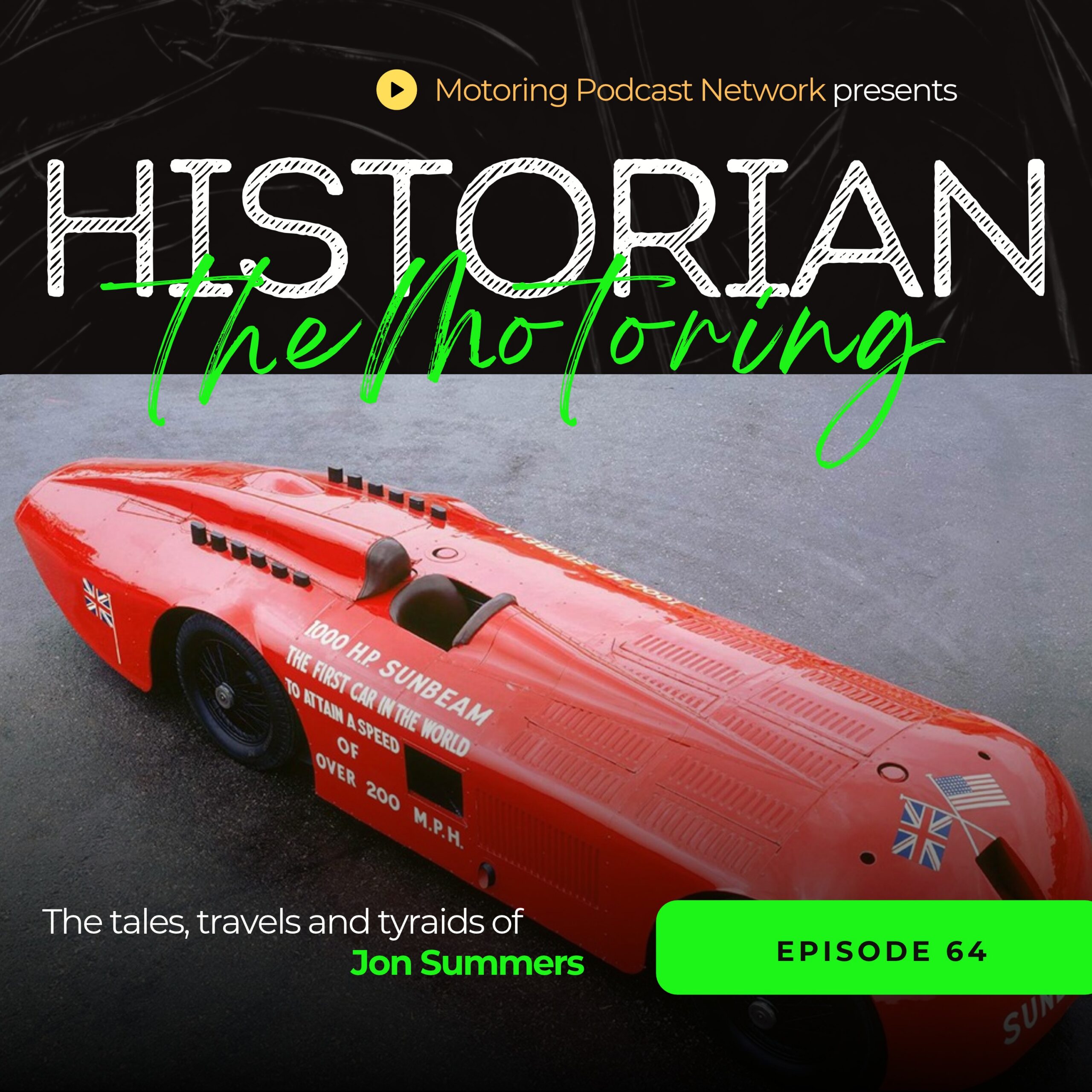
Motoring historian Jon Summers explores how “fastest car” benchmarks evolved into land speed racing, comparing early straight-line record cars to modern jet-powered machines like ThrustSSC. He highlights the 1,000-horsepower Sunbeam, the first car to exceed 200 mph, shown at Pebble Beach, detailing its twin 22.5-liter Sunbeam Matabele engines, chain drive, and the challenge of transmitting power, plus Sir Henry Segrave’s daring Daytona Beach record run and the beach-racing lineage that influenced NASCAR via Bill France. Summers recounts Segrave’s later fatal water speed attempt on Windermere, touches on Paul Baxa’s work linking interwar Italian fascism and motorsport martyr narratives, and connects motorsport’s “opera” to a Martin Brundle Le Mans anecdote. He then shifts to his experiences owning two Jaguar XJSs, describing ride quality, quirks, convertible history, braking concerns, central-locking mishaps, and the V12/TH400 grand-touring character.
Notes
Jon Summers is the Motoring Historian. He was a company car thrashing technology sales rep that turned into a fairly inept sports bike rider. On his show he gets together with various co-hosts to talk about new and old cars, driving, motorbikes, motor racing, motoring travel.
- The Fastest Car and the Land Speed Record of 100 years ago
- 1000hp Sunbeam
- Donald Campbell’s Jet Boat
- Gar Wood
- Miss England, Miss America and an understanding of the speedboat “plane”
- “Did we do it?”
- Paul Baxa
- Nicholas’ Foulks book on Bentley with Glen Kidston’s letter
- A Tale of Two Jaguars
- The History of Open Top Jaguar XJ-S’
- Hess & Eisenhardt
- Driving XJS’; the weak link, the Turbo 400 transmission
- The V12 – smooth, not revvy
Transcript
[00:00:00] John Summers is the motoring historian. He was a company car thrashing technology sales rep that turned into a fairly inept sports bike rider. Hailing from California, he collects cars and bikes built with plenty of cheap and fast and not much reliable. On his show, he gets together with various co-hosts to talk about new and old cars, driving, motorbikes, motor racing, and motoring travel.
Good day, good morning, good afternoon. It is John Summers, the motoring historian. So it’s intrinsic to the notion of the car To think of the fastest car, and we’ve, over the years, we’ve done a good job coming up with different ways of, of measuring the fastest car. You know, the one that can go up the hill, the one that can go from Paris to Bordeaux first, the one that can lap [00:01:00] around the Isle of Man TT course fastest, ’cause there was cars there before bikes if, if you didn’t know.
So these are different skills, right? And arguably the most pure form of contemporary motorsport, drag racing, is something that’s only existed in the post-war period. But I think there was something quite analogous to top fuel drag racing that took place 100 years ago. In fact, I would say it’s more than analogous to drag racing.
The vehicles were, are analogous in design in that you just have to go fast. But, you know, land speed racing, where the goal is the highest top speed, the kind of thing that people still do out at Bonneville, the heyday of that was, was 100 years ago and, and the cars that were designed were absolutely awesome.
It’s an overused word, but it was awesome. So they, they truly were awesome. So let’s sort of characterize them a little bit, that, that we’re gonna start off with fundamentally racing [00:02:00] cars just geared to go faster in a straight line. But then by the end of the First World War, we’re gonna start putting surplus war plane engines into touring car chassis with very light bodies on them.
And a lot of these cars had chain drive because the chassis flexed so much. And, and these are the cars that are gonna see us past 150 and 200 miles an hour. But beyond 200 miles an hour, as, you know, as we know, you know, any 400-horsepower car will do a buck 70, won’t it? A buck 70 or a buck 80, providing you take the restrictor off it.
But really above that speed, approaching 200 miles an hour to get close to 250 miles an hour, really aero becomes much more important. And, and regular listeners will know I love the Golden Arrow, which was, was the car that, that got beyond 200 miles an hour. Um, you know, and, and from beyond that point, land racing became piston-driven cars, then there were jet-powered cars.
Then in the post-war period, we, we evolved [00:03:00] to a stage where it was jet plane, war plane, surplus war plane engines on, kind of on little like roller skates. And, and, and these things took us beyond 500 miles an hour. Uh, and you know, the contemporary, the vehicle that holds the land speed record at the moment broke the sound barrier, ThrustSSC, piloted by a, a fighter pilot.
I think there were Rolls-Royce Spey jet engines. You know, and with this kind of land racing thing, you need to find a special place to go and do it so it looks… You know, the spectacle of it is awesome. So the spectacle of ThrustSSC breaking the sound barrier at 760 or 80 mi- miles an hour. I can’t remember exactly what it was.
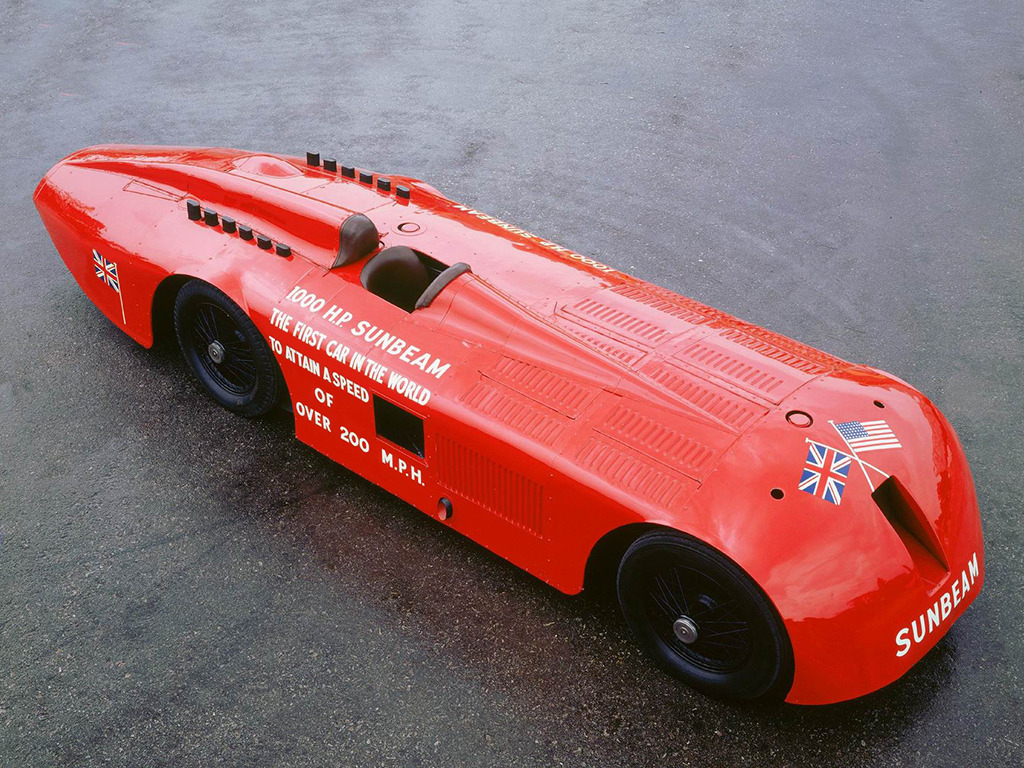
That was, uh, took place in the Black Rock Desert in Nevada, and that was a visually spectacular thing. Now what the devil does all of that drivel have to do with Pebble Beach this year? Well, this. The first car to 200 miles an hour, the [00:04:00] thousand horsepower Sunbeam, was on the lawn at Pebble Beach and was run up on the lawn at Pebble Beach.
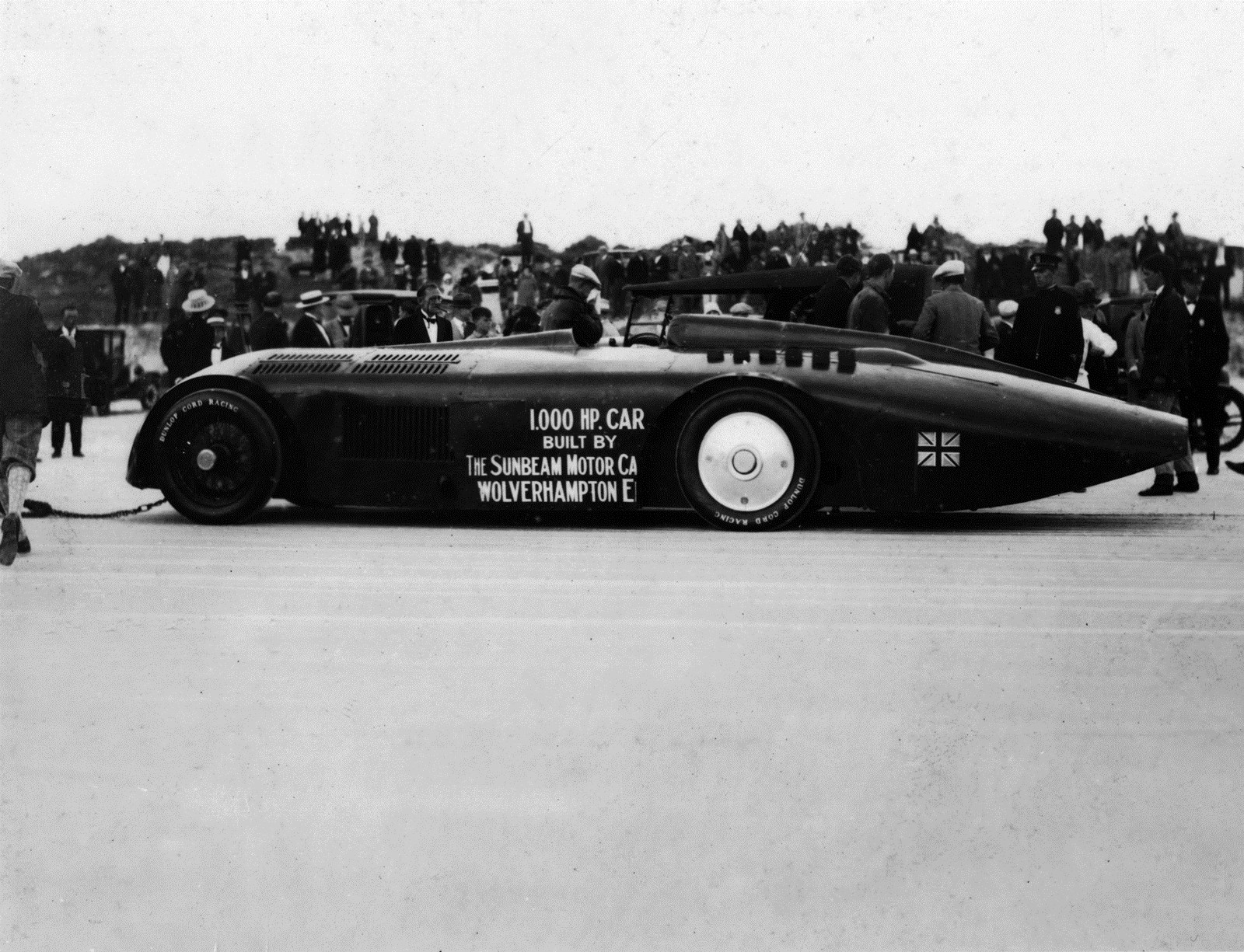
So this car has Two 22-and-a-half-liter Sunbeam Metabele aero engines. Now, they actually came out of a powerboat, but they’re always called aero engines, so I don’t know if they went into the, the powerboat. The powerboat sank in the war. They were taken out. They sat around the workshop for a bit. The whole project was a bit of a, of a shoestring kind of a deal, but the record at that time was about 180 miles an hour, and they were running out of space at the venues which they had been using.
Pendine Sands in northwest England was what they had been using. It was very bumpy. Um, Seagrave, the guy that drove the thousand-horsepower Sunbeam, Sir Henry Seagrave was his name, really interesting character, Seagrave. Irish mother, an American [00:05:00] father, but went to school in England, served in England in the First World War, decorated, very brave, one of these guys in the trenches who waved his pistol and said, “Over the top, boys,” one of those kind of, uh, fellows, a captain.
Really an astonishing character out, out of the car, but let’s, let’s stay on the, the, the thousand-horsepower Sunbeam. So this is, is really Seagrave’s project. He’s competing with Malcolm Campbell and the Blue Birds, and Malcolm Campbell has a whole succession of Blue Birds and is able to get a lot of support from the British government to do this.
So this is, uh, spirit of friendly competition, the, the two of them building these enormous hot rods to go really fast, and it, it being a pretty dangerous en- endeavor. So the, the guy that got to 180 miles an hour, um, on Pendine Sands, a, a chain snapped and, and hit him on the head, and he and the car were buried.
They were buried on a beach in Wales for… or northern England [00:06:00] somewhere, Pendine Sands. I’ve never been there. I need to, to go there and, and, and see. I was, uh… The connection, uh, so, you know, s- when Seagrave was at Pendine, he said it was so bumpy that one of the cars that he was driving, he had to, like, somehow wedge his leg, get his leg straight, and then wedge it, wedge his, like, ass cheek off the seat.
I can’t remember the exact turn of phrase in his biography, but basically wedge his foot on the throttle, ’cause otherwise, when you went over the bumps, your foot came off the throttle. That was the kind of guy Seagrave was. The book, by the way, is called The Lure of Speed, his biography. It’s up there on the shelf, and I’ve, uh, I’ve, I’ve never read it.
So, so this is the guy that drives the thousand-horsepower Sunbeam and is, is behind really the, the impetus to, to make it happen. So it has chain drive, um, rather than one engine, it has two. It, it didn’t really have a thousand horsepower. It probably had closer to about 800 Power. Who’s, who’s worrying, uh, uh, uh, that kind of level of power?
And this is when most people can’t afford a car, [00:07:00] and when your family car or, you know, your Ford Model A is gonna do 45, 50 miles an hour. So that means that this is a car that’s gonna be comfortable on a, a suburban road, but not comfortable on a suburban freeway, and definitely not what we would consider a highway car.
That’s what most people’s experience of a car was like. And there’s this 40-liter, 800,000 horsepower monster. They called it the Slug in the factory, for obvious reasons if you look at the, uh, if you look at the shape of it. These two engines are mated together with a bespoke gearbox, and I think this is the most interesting aspect of the design, and if you’re really interested in the vehicle, the whole g- gearbox and final drive and clutch mechanism, and what they did in period versus what they do now, and the way that the materials are different.
This is all extremely, uh, interesting. And with all of these cars, certainly the wheel-driven ones, arguably the most interesting element of the design is [00:08:00] not the enormous engines. It’s getting that power to the ground, which makes them curiously similar to, you know, my, uh… I’ve been playing with, uh, electric dirt bikes with, uh, with my son, and i- the cheaper ones, the power delivery is horrible.
The, the, you know, when you come in the throttle, you can’t come in smoothly, and that is disappointing because as you open the throttle, the torque fades off. The better ones, there’s torque modulation. How weird is it that the thousand horsepower Sunbeam and the modern Amazon e-bike share the same challenges around transmitting controllable…
Anyway Point is that when you’ve got the rear engine going, there’s a lever next to the driver, and you push the lever forward, and that engages the front engine, and then it starts as, as well. Now, I was talking about Pendine Sands not really being suitable as, uh, as a place to drive these things to, to their potential.
[00:09:00] So, uh, uh, old Segrave there looked around and settled on Daytona Beach in Florida as being a good place to go to do these, uh, speed records. Now, it would be when Malcolm Campbell came and went 272 miles an hour that Bill France watched and thought, “Hmm, a car race on the beach. Lots of people come and watch.”
So this tomfoolery on the beach with these ridiculous hot rods that was started by Segrave and Campbell arguably did give us NASCAR because Bill France saw the potential and thought, “I can monetize that.” When he called his championship the Grand National Championship, it was named after the Grand National Horse Race in England.
Well, where do you think he got the idea of looking at England? Well, because these English guys had come and had been speed kings on the beach, hadn’t they? So Segrave, right? He, for all the, like, you know, poshness, the guy had, uh, you know, balls of steel. Let’s not mess around. On the [00:10:00] dyno, he was afraid of the car.
Afraid. He said at sea in the car, it was the first time he thought that perhaps he wasn’t gonna be able to control this car. Now, the report is that through the measured mile, I don’t know quite how it happened, but he got a bit of a slide on with it, and he exited the measured mile for the land speed record.
He exited it in something of a slide. So the course is 10 miles long, and the measured mile’s in the middle. In order for the car to be an actual car, not a firework, the way the, the land speed record works is you can’t just go up there and then be like, “Oh, it’s broken now.” You have to go up and turn round and come back.
Now, that leads to some discrepancies because Mickey Thompson out at Bonneville went faster than Donald Campbell did, around about 400 miles an hour. But Mickey Thompson only went in one direction because Bonneville’s only in one direction rather than… Uh, was that car a firework? No, but the point about the land speed record is, is you go, you turn round, you come back.
So Dunlop had [00:11:00] certified tires on the 200-horsepower Sunbeam for, like, something like, you know, three seconds at 200 miles an hour or 30 seconds at 200 miles an hour or something like that. So i- in other words, you did one run, then you were gonna fuel up, change the tires, and then run back. That was the way it was gonna work for, for Segrave.
So the course is this, is four miles to work up to speed, then the measured mile, then four miles to slow down. So he exits the measured mile foot flat with the thing in a slide, trying to get away from him, then the brakes don’t work properly on the slowdown. And as he’s approaching the end of the course, he’s like, “Shit, what am I gonna do?”
Drives it into the sea slows it down. Do the tires turn around, he hacks back off down the beach and sets the record. The car had three gears. Like, the top gear was set for, like, 212 miles an hour, so, like, second gear was set for, like, 130 or something ridiculous like that, and first took it to about 50.
I’m sure you can work out the ratios that he would have. But just think of what a stupefying machine it is just altogether and, and all round. It’s also, [00:12:00] uh, you know, it would be remiss not to wrap up with, uh, a couple of details about, you know, Seagrave separately from the land speed record. Um, after the land speed record, he went on to do the water speed record.
A lot of them did that, and, uh, candidly, guys, if you, if you look at the history of, of land racing, the water’s fucking dangerous. Really, really dangerous. What happens is if you go up, when you turn round to come back, there’s still the ripples. But the, these kind of speed king guys, they, they operated on adrenaline, and they felt like it was about luck, and, and they maybe didn’t wait for the, the water to clear.
That’s certainly what happened to Donald Campbell in the ’60s with a jet boat. If you could imagine a pontoon jet boat on a lake in England. I’ve been there. It’s narrow He used Coniston because Windermere was where Seagrave was, was killed. What happened was is that Seagrave was [00:13:00] competing with this American fellow Gar Wood for the water speed record.
Wood made his money hydraulic lifts at that time for coal trucks. So he had the hy- he made his money, you know, Gatsby kind of money, by developing the hydraulic press that lifted tipper trucks. So instead of you having to shovel the coal out when you went to everybody’s house, you could tip the bed up to tip the coal out.
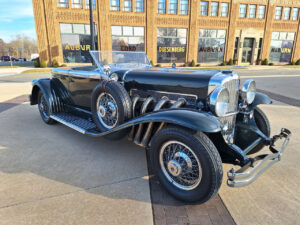
It was a game changer for coal delivery. It made Gar Wood a multimillionaire. Used that, some of that money to powerboat race. His boat, Miss America, I mean, there were some of them at, uh, there’s Mecum sometimes has ones to sell. These things have, like, two V16 Duesenberg engines. I mean, these are, and made of this beautiful veneer wood.
Well, Gar Wood knew how to get the thing to come up on the plane, but old Seagrave there with his Miss England, they didn’t really understand the plane properly. Now, people might school me on this, but that’s what I think was, was the gist of it. So in, in other words, [00:14:00] uh, Wood’s boat would properly rise up out of the water in the way that if you’ve watched credits of Miami Vice, the way a cigarette boat does, the way a modern, you know, speedboat does or powerboat.
Whereas Miss England wouldn’t rise up out of the water properly. Well, you know, the inevitable happens o- on Windermere. Seagrave’s made one pass, he turns around, he makes another pass. It’s rough. The boat is hit. It breaks up. Rescue vessel with his wife on board, they go out and they find the body. They pull Seagrave’s body on deck.
Miraculously, he’s still alive. He, uh, he’s with his wife, and she’s got his head in, in her lap, and he comes to, and he says, “Did we do it?” And she says, “Yes.” And then he dies I mean, it could be a movie, couldn’t it? Now, as if that wasn’t absurd enough, there is, uh, an academic who does some really interesting work.
He’s named Paul Baxa. He does some really interesting work at the intersection of fascist politics, especially Italian [00:15:00] interwar fascist politics, and motor racing because, you know, the fascist parties, it really worked, especially for, for the Italians almost more than the Nazis. It worked for the Nazis as an expression of, like, modernity and German power and all of that.
It was like an advanced guard of the Panza, the Silver Arrows teams of Auto Union and Mercedes were. But really, you know, Mussolini’s fascism, they looked at motor racing in, in a slightly different way. Baxa has this really interesting piece about how motor racing drivers were talked about in sort of heroic terms.
They were heroic martyrs, and that brand of fascism, that Italian brand of fascism, it needs these, um, heroic martyrs. It needs people to die on the altar of speed. Well, Baxa had this piece where he talks about this Italian philosopher. The bloke’s name escapes me now. But when this chap died, in his house, there was an altar, and on the [00:16:00] altar, there was the steering wheel from Miss England, all bent and twisted up, that Seagrave’s wife had given him.
So think about what’s going on there is not only a Seagrave and his wife associated with these people who have all this right-wing politics going on. But more than that, there’s a recognition, the, the Seagrave’s widow recognizes the spiritual connection this guy has, the need to go fast. It wasn’t some…
Well, I guess it was for Seagrave. It was a hooligan desire, but it was this deep spiritual calling that defined who he was. So it’s this Glen Kidston thing. So Glen Kidston was one of the Bentley boys. You know, there’s, uh, an awesome book by a guy called Nicholas Fowlkes that looks at the culture around the Bentley boys a little bit, and one of the things on one page, it, it reproduces an [00:17:00] excerpt from a letter that Glen Kidston writes to a nephew.
Now, the Bentley boys were all wealthy and didn’t need to work. They were independently wealthy. They were like a character from The Great Gatsby, an English version of that, wealthy playboys. You know, the leader of the Bentley boys, Woolf Barnato, owned the Bentley company as a hobby because his main business was diamond dealing.
Kidston, one of the Bentley boys, writes to his nephew, “The fellow who has to earn his own living has an excuse for doing nothing.” Think about that. If you have the work, it’s fine not to do anything, to do nothing noteworthy. But if you are independently wealthy, you are duty-bound to go out there and do something great with your time, and your energy, and your courage, and your wealth.
Kidston died in 1930 when his plane broke up over Africa when he was big game hunting. Bit like Curtis Turner, right? [00:18:00] That was a plane as well. Who really knows what happened? I just feel like there’s something… It’s like a s- it’s like Valhalla in the Steel Age to go out in a plane like that where nobody really knows what happened to you.
I mean, I don’t know when they found the wreckage of Kidston’s plane. I don’t know when they ever found whe- whether or not they ever found the body. Of course, his nephew is Simon Kidston, the classic car broker that we, uh, that you know of today if you knock around the classic car space. So Seagrave was very much of that kind of, “I’m doing this for the sake of it.”
It was a spiritual quest. And of course, that’s why Seagrave’s widow is giving the Italian fascist philosopher, the name of which escapes me, is giving him the steering wheel. But for this fascist philosopher to have a Christian altar in his house, firstly, so Italian, right? But, you know, the [00:19:00] juxtaposition of fascism and modernity and the altar, that can all exist together, and the motor racing being center, f- for me, that was huge because it captures the spiritual thing which is imbued in motorsport, right?
That’s why Ferrari is the heart of Formula 1, because it’s this romantic, spiritual kind of thing. It’s linked to this, Ferrari himself wanting to be a sports journalist or, or an opera singer. And you, of course, you’ve, you’ve achieved both of those things, haven’t you? Because he doesn’t write about the news, he is the news.
And he doesn’t sing in the opera, but the sport is fully an opera, right? It’s an opera of triumph and tragedy.[00:20:00]
contextualize that. I remember reading an article in the Plymouth Evening Herald motoring supplement where Martin Brundle had been interviewed talking about his experience in the silk cut Jaguar XJR-12 that he, he won with. And he talks about being shaken awake at 2:30 in the morning and getting in the car and being out on the Mulsanne Straight within a couple of minutes of being woken up and within 30 seconds of strapping in the car.
This is a car which has now done 2,000 racing miles, 1,500, 2,000 racing miles. The last couple of hundred you haven’t even been driving it, so you don’t really know what the tires are like or what the brakes are like or whether it’s, like, been curbed and it’s pulling a bit on the straight line. You have no idea of that, but that doesn’t matter.
You’re just strapping in and [00:21:00] taking it to the red line in each gear and then running down Mulsanne at better than 240 miles an hour. That’s the anecdote that I always think about with Group C more than anything else. I mean, at the time everyone moaned about it being a fuel formula and, you know, “Oh, everyone’s just driving to finish rather than actually racing.”
But all of that absolutely doesn’t matter now because the cars spit fire. They sound awesome. You know, Rothmans livery on the Porsches is incredible. You see a lot of Mazdas, Miatas. Well, not a lot, but I must have seen three or four Miatas, you know, uh, uh, like a ’70s Mazda wagon in the orange and the green of the 787B, the renown, um, livery of the, of the 1991, um, Mazda Le Mans winner.
So recently I’ve spent a bit of [00:22:00] time with, uh, a Jaguar XJS. I actually had two. I bought one, it came with a parts car, and then I couldn’t find housing for the parts car, and parts car didn’t have brakes, and it drove on the trailer, but then I couldn’t get it to drive off the trailer, and it was just an absolute fucking debacle trying to get this thing off the trailer.
If I tell you that there was a moment in Walgreens where I was looking at a $200 jump starter to try and get it to crank fast enough to start or a tow rope, and I was just like, “Fuck it, dude. Buy the tow rope.” And I just attached the tow rope to, I think Dana’s BMW, just reversed and pulled this Jaguar, this brakeless wonder, off the U-Haul.
So I fell out of love with the convertible parts car and, uh, uh, g- that’s gone to John. But the, uh, the other car I’ve been driving around a lot and it, it really does scratch the Jaguar itch. There is a ride quality at a certain speed which is [00:23:00] unmatched. Objectively, not that fast, not that powerful, not that comfortable, but the wood and leather allied with this indecent turn of speed And then this, I can only describe it as Concorde-like complex British engineering of the 1970s.
Now m- my car, ’cause it’s a 1990, it has weird things like airbags. It also has cooling system from a Mercedes Benz. Yeah, so it’s something of a hot rod. I, uh, also as it was… I think it was in a carport in LA for years and years and years, ’cause the paint on one side’s okay, but the paint on the other side is terrible.
It’s blue, but it has a red hood, red bonnet, and I found looking through, I was sitting outside the baseball academy whilst the boy was taking ages finishing his baseball practice the other day. I was looking through the handbook, and out of the handbook fell some photographs of it with the hood [00:24:00] twisted up.
So I’ve been looking to see if I can, like, get the dates. They look quite old, so I don’t know how long it’s had the mismatched hood on it. If I… Maybe that was even why it was, uh, parked up. It only has 79,000 miles on it. You feel like you’re sitting on the floor. In the first couple of weeks of use, I got the brakes to start grinding, so I was like, “Oh.”
So you look at the brakes and you read up, and then you realize that these earlier cars, they have inboard rear brakes, so if you need to change the brake rotors, the brake discs, you need to take apart the whole differential. Well, I mean, I, there was no way I was gonna do that, and it was gonna cost, like, half of what I paid for the car.
I mean, I took it into a place. Luckily it wasn’t that. Luckily, I dislodged the handbrake shoe. So the guy was like, “I’ll repair the handbrake for you, but, uh, you know, these are, these are heavy cars, and you live in the city, you say? You live in San Francisco?” I’m like, “Yeah.” He’s like, “Yeah, you know, they’re, they’re not really meant…
The handbrake reason [00:25:00] isn’t really meant to hold the car’s weight on a hill.” I come off the phone with him and I’m like, “So, so this chrome lever, which is a fly off handbrake on your left wheel, I mean, it’s just really quaint.” I mean, I know I’m an English person talking in that patronizing way about American culture, but it really is.
Quaint is, is the word because it’s quite a heavy car. Not really meant to hold the weight of the car. Well, what is it? It’s just some fucking decorative chrome lever, is it? Yes. Yes, John, it is. You may or may not know the whole story with the XJ-S was that I think looking back there was a bit of a bait and switch.
The American government told the British that there were gonna be no more open top cars. The TR7 and the XJ-S were designed as hard tops. The XJ-S replacing the E-Type Jaguar, like the quintessential roadster. But that ban on convertibles never happened. So almost from the very beginning, there was a [00:26:00] desire to have an open top XJS, ’cause the first XJS came in in ’75.
Mine’s a 1990. The model lasted till like ’93. Early ones, what they did was they did a sort of Targa, like a Porsche Targa, where the middle was, of the roof was missing, but there was still like structural rigidity behind. There was a sort of roll bar. They called that one the SC. There was a full convertible later on from the factory.
In between then, there was the convertible that was the gold one that I had, where there were about 800 cars that were assembled by, or disassembled I guess, you know, cut the roof off, vzzt, vzzt, somewhere in, uh, the Midwest, Indiana somewhere, but German-named company, Hess & Erdinger. They were basically cutting the roofs off them and doing a proper convertible, because the gold car that I gave John is a proper convertible for these Hess & Erdinger, whatever, guys.
It has r- had rust. It has rust. John thinks he might be able to make it live. [00:27:00] We’ll see about that. It seemed like a uphill struggle to me, and I’ve not done 1,000 miles in my car yet, and it’s been… Oh, it likes to give you problems. Let me illustrate the kind of little issue that, that one has with it, is that I was checking the oil and I left the key on the seat, and I let the door go closed.
And when the door went closed, I checked the oil, and when I went to get back in the car, well, as I touched the door handle, central locking triggered and locked the car. So now I’m locked out. So I had to like call a locksmith and, you know, coat hangers, scooping up the key, and you know, now the passenger door doesn’t close quite as well as it used to.
As I say, all is forgiven by the high-speed ride, right? The ride on the highway is just sublime. You may or may not know XJS V12s have a Turbo 400 transmission like, you know, a Chevelle or a Caprice or something like that. And actually, it’s robust, but it, it’s lethargic and it [00:28:00] shifts a bit hard, and it kicks down okay.
It matches the torque of the engine. It’s not like you wish that you had a manual. It, it, it really makes for a really nice driving experience, but the gearbox is sleepy. The gearbox is the, the missing link. It, it, you wonder, you wonder what it’d be like with a shift kit and a higher stall convert, you know?
Um, yeah. But of course, that’s one reason why when people had problems with the V12s, they often put in a Chevy small block straight, because it would bolt right up to the transmission there. So it’s not revvy and it’s not a noisy engine. It’s super smooth. Yeah, far more of a grand tourer than a sports car.
Thank you. Drive through.
This episode has been brought to you by Grand Touring Motorsports as part of our Motoring [00:29:00] Podcast Network. For more episodes like this, tune in each week for more exciting and educational content from organizations like The Exotic Car Marketplace, The Motoring Historian, Brake Fix, and many others. If you’d like to support Grand Touring Motorsports and the Motoring Podcast Network, sign up for one of our many sponsorship tiers at www.patreon.com/gtmotorsports.
Please note that the content, opinions, and materials presented and expressed in this episode are those of its creator, and this episode has been published with their consent. If you have any inquiries about this program, please contact the creators of this episode via email or social media as mentioned in the episode.
Highlights
Skip ahead if you must… Here’s the highlights from this episode you might be most interested in and their corresponding time stamps.
- 00:00 What Is Fastest?
- 01:54 Land Speed Evolution
- 02:50 ThrustSSC Spectacle
- 03:51 Pebble Beach Surprise
- 04:08 Inside Sunbeam Slug
- 08:52 Daytona And NASCAR
- 09:59 Seagrave Record Run
- 11:59 Water Speed Tragedy
- 14:46 Speed And Fascism
- 19:17 Motorsport As Opera
- 21:58 Jaguar XJS Misadventures
- 25:29 XJS Design Backstory
- 27:01 Living With The V12
- 28:55 Wrap Up And Credits
Enjoy more Motoring Historian Podcast Episodes!
The Motoring Historian is produced and sponsored by The Motoring Podcast Network