
Motoring historian Jon Summers recaps Pebble Beach 2026, focusing on the Best in Show: Clark Gable’s freshly restored 400-hp short-chassis Duesenberg SSJ, alongside notable Duesenbergs like the “20 Grand.” He highlights show-field storytelling through juxtaposed classes—streamlining to aerodynamics experiments—featuring the Round Door Rolls, Phantom Corsair, and Japanese Group C and other JDM race cars, plus Jaguars including a Lady Diana XJS and Bob Tullius’s caged racer. Summers’ favorite is a preserved Hispano-Suiza, emphasizing patina and smell over faultless restorations, and he reflects on how noise and odor may gain importance with electrification. He also discusses Car Week auction dynamics (record totals, Ferrari strength, a charity $40M Ferrari “Luce,” and McLaren F1/GTO comparisons), the K-shaped economy and investment-grade collectibles, and shares Laguna Seca paddock encounters with Kenny Roberts, Eddie Lawson, Wayne Rainey, and Ford CEO Jim Farley.
Notes
Jon Summers is the Motoring Historian. He was a company car thrashing technology sales rep that turned into a fairly inept sports bike rider. On his show he gets together with various co-hosts to talk about new and old cars, driving, motorbikes, motor racing, motoring travel.
- The Duesenberg ‘20 Grand”
- The Winning Car – Clark Gable’s Duesenberg SSJ
- The Lives of Great Cars: a few years of use and lots of sitting
- Packard Wrecker Truck
- Gotham City Cars: the Round Door Rolls and the Phantom “Ketchup” Corsair
- The Three BAT cars
- The Nardi Blue Rays
- ZZ Top Eliminator Hot Rod
- Alfa 2900B
- J’s Et Ceterini – the thumbnail Vignale Abarth, better in silver than red I think
- Group C at Laguna Seca: a pinnacle spectacle
- Le Mans in the Eighties
- Favourite car, the Preservation Class Hispano-Suiza; restored, it would not have stood out
- Why do the Preservation Cars touch me more than the million dollar restorations ?
- The smell of old cars compared to the sound of racing cars
- Pebble Week in Review – prices at the tippity top of the market
- Nick Mason’s Pop Art McLaren fails to beat the Bianco Speciale GTO ($35m)
- The $40m Ferrari Luce
- Switchcars / Doug Tabutt
- Thoughts on the Luce
- Luce vs. NART Daytona; 206; Testarossa
- The $7xxm Pebble sales results led by a few very expensive cars
- Pebble seems to have more rich parties for GT3-owning AI Tech Bros
- The Great Wealth Transfer hits the classic car market and drives bonkers noughties hypercar values
- J wants to collect twenties cars but sees too many hurdles
- Kenny Roberts, Eddie Lawson, Wayne Rainey, Jim Farley and my mate Jason’s Dad
- A thumbnail of Flat track racing
- On Any Sunday
Transcript
[00:00:00] John Summers is the motoring historian. He was a company car thrashing technology sales rep that turned into a fairly inept sports bike rider. Hailing from California, he collects cars and bikes built with plenty of cheap and fast, and not much reliable. On his show, he gets together with various co-hosts to talk about new and old cars, driving, motorbikes, motor racing, and motoring travel.
Good day. Good morning. Good afternoon. It is John Summers, the motoring historian. The dust is settling on Pebble Beach 2026. I guess it’s probably settled for most people already, ’cause it’s, like, a couple of weeks ago now, but I always take ages to do anything, don’t I? I actually wrote my thoughts down ages ago, but all right, Pebble Beach 2026.
So the [00:01:00] first thing that we should talk about, or that I, I’d wanna talk about, is the car that won Best in Show. There’s Duesenberg classes every year at Pebble Beach, isn’t there? And, and even if there are… isn’t, like, a specific Duesenberg class, they fit into other classes like American, you know, Interwar Closed and American Interwar Open, and these other kind of classes.
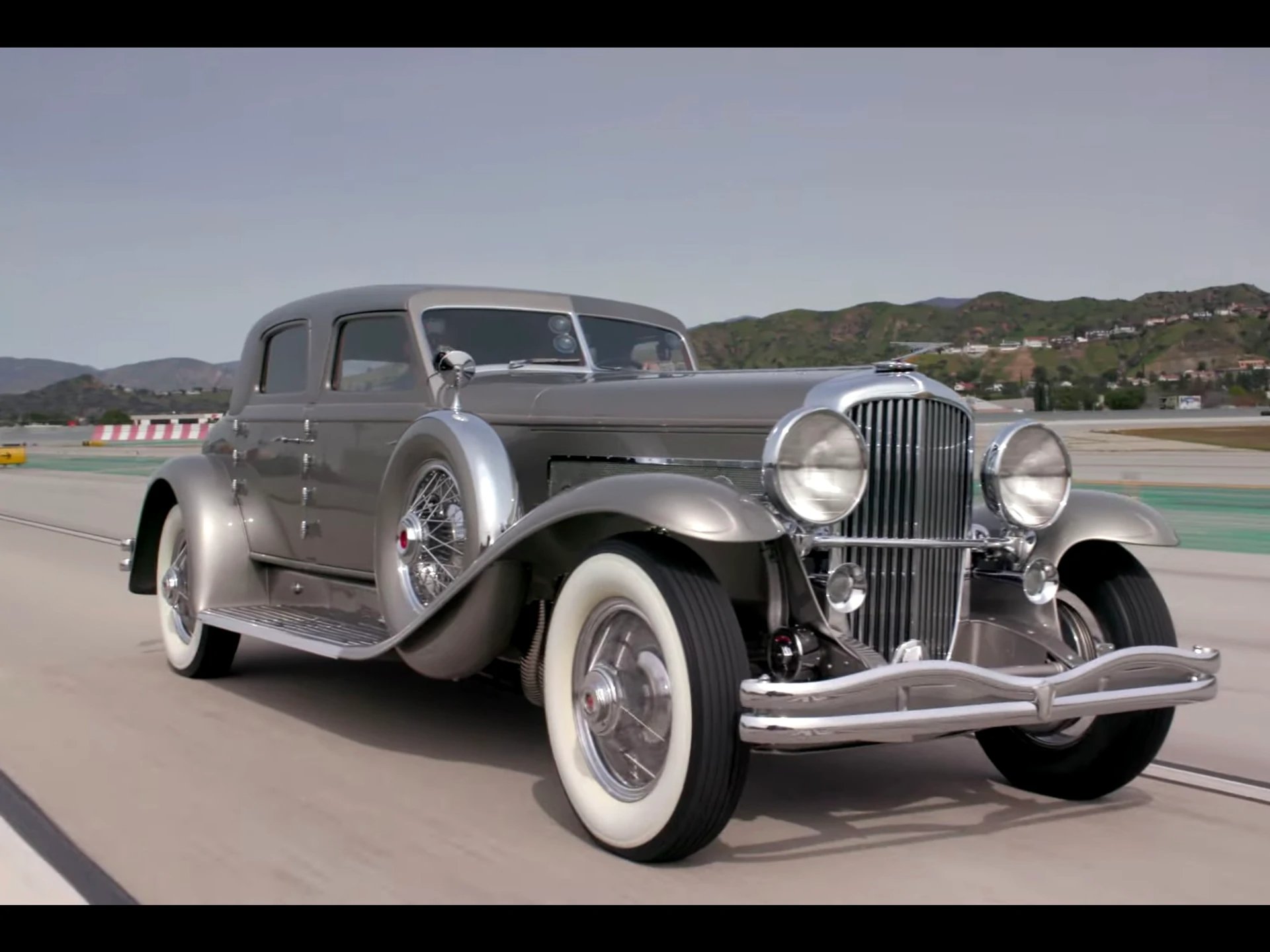
So rather like Ferrari, there’s always a massive presence. But, you know, this year was a standout in terms of the number and caliber of Duesenbergs that they had. There’s one car called the 20 Grand that has a really interesting B pillar design. To contemporize, it had a very modern kind of shape. I think it was even the car that was used for the World’s Fair or the Festival of Progress, whatever they were calling it in 1933.
You know, it was like a… It was o- one of those, uh, kind of… ‘Cause I think Gordon Buehrig [00:02:00] even designed it, if my memory serves correctly. But the point is that although most people were buying cars that, you know, you could wear your top hat in, and, you know, had front seats and back seats and basically walked and talked like a Suburban might do now, there were designs that were different from that, right?
So this 20 Grand is, uh, is one of those. Well, obviously, if you were all about performance, you would do a short chassis, and you would do the big motor, and you might do two-seat coupe And those are super impractical if you think about the size of the car where, you know, you could have like seven seater like a Suburban, not as three rows.
It would have- they would have facing, that’s what the seven seats were like as well as the space in, in the front. In order to make it look more stylish, you can have a coupe body style that only seats two people, the, the two front seat passengers there. But even lighter and, you know, more rakish in performance than that is for that to be a roadster, for that [00:03:00] vehicle to have no roof.
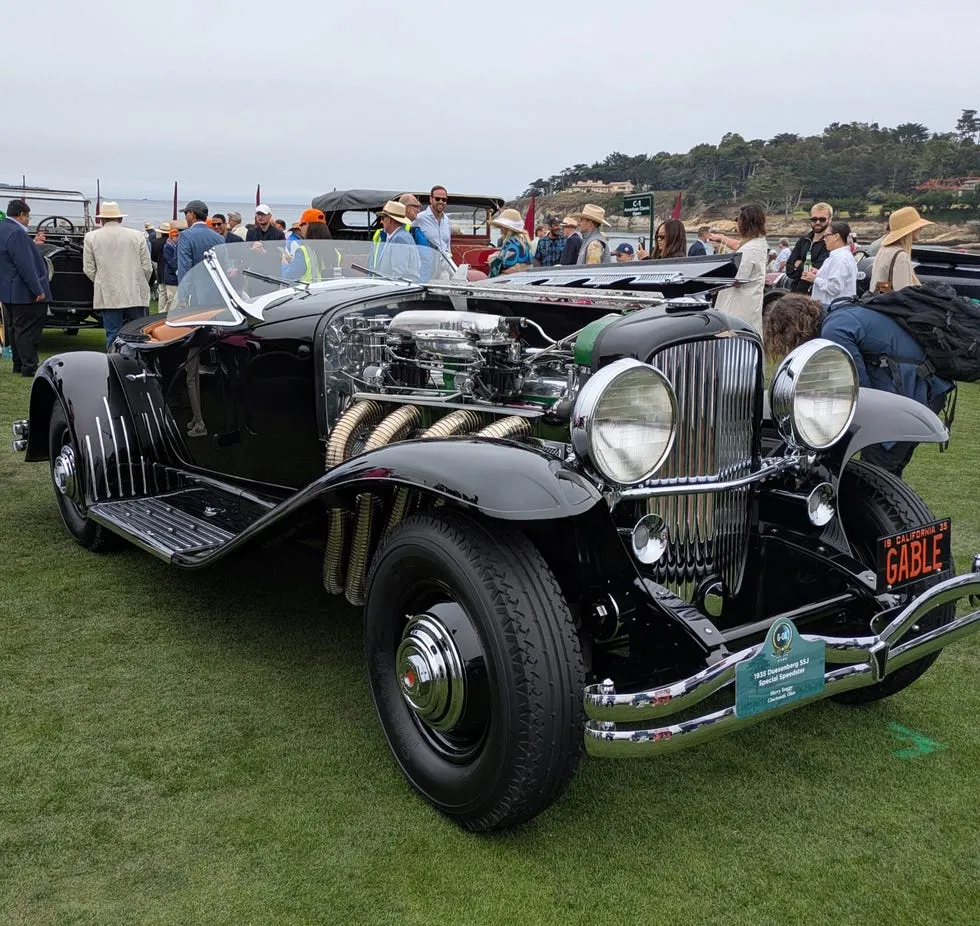
Amongst all these long wheelbase Duesenbergs, and if you listen to my prattling about the museum, you know, a time when Bentley was winning Le Mans with cars with 200 horsepower, Duesenberg Model J’s had 265. The supercharged ones had 320. There were two short chassis, sort of mega supercharged. I didn’t drill into exactly how this happened, but there were two 400 horsepower short chassis SSJs built.
Now, the Pebble blurb all talked about how this was to distract from the fact that Duesenberg were going bust. The- these two cars were built, one was black, one was sort of two-tone silvery gray. Uh, one went to Clark Gable, the other went to Gary Cooper. They were both the Brad Pitt, Leonardo DiCaprio of their day as it were.[00:04:00]
Now, the gray car I had some contact with before Because after Gary Cooper, it passed to Briggs Cunningham, and from Briggs Cunningham, it became part of, you know, Miles Collier’s inheritance, and hence the Revs collection. He parted with that car, uh, you know, in order to free up the money to do fu- to do a project that was associated with saving, preserving, encouraging the appreciation of, of old cars.
In fact, I have subsequently felt that the sale of the car was more a way to jolt collectors into thinking, “Wow, if Miles Collier’s selling, maybe I should think about downsizing what would happen to my collection in future.” You know, it was, I, I, I felt it was more than about seeding funds for a project, although it was about seeding funds for a project.
So that’s the gray car. The black car, the Clark Gable car that won the show, that apparently [00:05:00] had come off a fresh restoration. I saw the car on the lawn, didn’t actually look too closely at it. I- this has never happened before in all the years I’ve been to Pebble Beach. I’ll, I’ll hold up my hand and say in years where I’ve been a docent, there have been more years than not where I have not even seen the winning car on the lawn, let alone looked at it and thought, “Oh, that car is going to win.”
And that’s not least because the winning car is often an interwar car, and I’m not really an interwar kind of guy. So if there’s Vignale-bodied Ferraris there, which there were lots of this year, that’s where my attention tends to, uh, to fall, you know, the post-war stuff. You know, and they often have classes that are aimed at younger people, and being under the age of 65, I count as a younger person for the Pebble crowd.
So that means, you know, this year they had some Japanese cars, including Mazda 787s and Tom’s Toyotas and, and that kind [00:06:00] of stuff, and I’ll talk about that a little more in a moment because they had all that stuff out at Laguna, and we camped out at Laguna as well and, and experienced the JDM Group C in all of its glory To return to the lawn of Pebble itself and Duesenberg and this, uh, Clark Gable SSJ, I mean, you’ve seen the pictures, you can judge whether or not you think it’s elegant.
You can judge whether or not you think the black car’s better than the gray car. You can judge whether you prefer the wire wheels or the disc wheels. I think I prefer the wires. But if you squint a bit and you imagine the black car on the wire wheels, like body color painted wire wheels, I think right there you- you’d have…
You know, for me, that’s what I would consider peak elegance. And, you know, in some ways, this is an object lesson in what makes a Pebble Beach winner, right? The- the- this is a fresh, exquisite, faultless restoration, and the car is the very best of the very best. It’s Duesenberg, which is the best of the American marks, and this [00:07:00] is one of only two short chassis cars that had that 400 horsepower, as well as the celebrity ownership.
Now, I believe if you go to, I don’t know what chain of cinemas it is, but I was, uh… I went to the cinema with my family to see the Brad Pitt Formula 1 movie when that came out, and I noticed when in the restroom there was a photograph of Clark Gable sat in an Olympian-era car. Don’t know if it was a Duesenberg, but I did find myself thinking, I wonder if that car is the actual car that won, uh, Pebble Beach.
Quite an interesting thing, isn’t it? The company’s going bust and you give the cars to these two celebrities. It does make you wonder how much they drove them and- and what sort of happened with them. ‘Cause one of the things that Really struck me with cars that were bought, that I wrote about for Gooding when I was writing for Gooding.
It really struck me that a lot of these cars, like Ferrari BBs, I wrote about a series of those, where it seemed like after they’d [00:08:00] done, like, 3,000 or 5,000 miles and were, like, three or five years old, clearly something happened for the owners to be like, “This is too annoying to drive in traffic,” or, “I’ve had a little fender bender in it,” or, you know, “It keeps getting vapor locked on the 405,” or, “Norm, you know, my left foot…”
Okay, you know, something happens for them, and, you know, you love the thing, so you don’t sell it, so it sits. And, and then, you know, it’s how many times it changes hands and who decides to do the recommissioning. And generally, the less of that that’s happened, the better the cars seem to me to be when Gooding can be write about…
I, I, I feel like I wrote about half a dozen Boxers that seemed to have, like, this kind of history, but then of course other cars as well. Maybe that’s just the pattern of those kind of cars. So my sense is, right, that’s what would’ve happened with Duesenbergs. And in fact, I was watching YouTube where a fellow was showing a Packard that had been converted into a wrecker truck.
In fact, it was a Tom Cotter, it was Barn Find Hunter, [00:09:00] and Tom skillfully drilled that little bit deeper to be like, “Wow, it was only on the road, if this is a ’29, you know, it was only on the road so, or if this is a ’32, it was only on the road seven years before the wrecker body was put on it.” And it… So that is to say this Gatsby era where they flourished was extremely brief because the war came, and with it, the scrap drive.
So a lot of these cars were actually lost at that time. Y- those that weren’t, you know, if you think of post-war cars, th- this is why these cars were on used car lots alongside the blobby guys of the 1940s at ridiculous prices in the 1950s, and of course led to the whole collector car movement from there.
So the Thousand Horsepower Sunbeam gave me a chance with my people on my tours to talk not just about the land speed record, [00:10:00] but to talk about Segrave as well. And as usual with these things, the cars are awesome, but the, the people are, are equally awesome, and the stories around the people are as remarkable as the design of the, as the design of the vehicles are.
There were a couple of, of what I would call Gotham City cars there. You did hear me right. They’re like Gotham’s, you know, the city where Batman’s from. It’s all dark and stylized, isn’t it, right? Or stylized, it’s always raining. Prime place along the lawn, you know, in the, the first car in the row, so the natural car for you to begin your tours if you’re a docent doing a, a show field tour.
The place where I met my son, both of us sitting rather tiredly looking at this actual car, the round door Rolls. Google it up. It’s in the Petersen Museum. Now cleverly, Pebble had done this cl- And this is something, right, that if you d- have never been to [00:11:00] Pebble, you, you won’t appreciate it. But it’s really one of the things I enjoy the most about Pebble, is the way they do juxtaposition of the class, right?
So, so this Round Door Rolls was in the streamlining class. Next to streamlining, they had moved out onto aerodynamics and aerodynamic experiments, and they had the Batcars of the 1950s and the two naughty Blue Ray cars, which we had in the Blackhawk. And those cars are not for driving. Those cars are for looking at.
They always were for looking at. They’re really interesting culturally about, you know, where the companies were. It’s about the past, it’s about the fut- It’s really, uh, um… So, and look, aerodynamics is partly done with wind tunnels. The Japanese cars and, you know, the 787 and Le Mans cars were, were there as well representing downforce.
So you had streamlining, that looks fast, giving way to aerodynamics. We [00:12:00] maybe worked in a wind tunnel giving way to what’s actually gonna get us down Mulsanne fastest, but still give us good downforce around the kink, and still give us good downforce around Indianapolis because, you know, that story was, was told right there.
So this Rolls has a round door. That is the distinctive feature of it. But actually I think almost more distinctive is the giant grill. ‘Cause you’ve probably heard me say before, and you’re probably aware, that these interwar Olympian cars, you bought the engine and the chassis and then somebody else did the body for you.
Well, that meant if you were gonna have brand recognition, if you were Volvo or Mas- uh, not Volvo, if you were Bentley or Duesenberg or Marmon and you… Or actually that’s a bad example ’cause they sort of did in-house. But, uh, generally speaking, the grill and the front of the car was what was recognizable, and then a local coach builder would do the body.
So the, the coach builder is often somebody who built coaches for [00:13:00] the family buying the car for generations before, right? So, uh, Italian car is gonna have, likely have an Italian body unless it was imported to England, in which case it might have a British body on it, leading to some really interesting combinations of engines and, and bodies and, and all this kind of thing.
So the grill shape is sacred though, right? ‘Cause that’s how you’re gonna recognize the car. Like, you know, you recognize a Packard now ’cause it has the fluted grill. You recognize a Duesenberg ’cause it has the mustache bumper and, you know, the headlights and the grill. That’s the, the signature look if, if you will.
The Round Door Rolls has a custom grill on it. It’s a Rolls-Royce grill, but it’s like leaned back. It’s as if the ZZ Top Eliminator hot rod and a normal Rolls-Royce had a baby. Like, it’s got this big lean back grill. It’s got this massive high hood line. Hans, one of the other docent at the Petersen as well, and I have to say, uh, yeah, Hans Kraakee is the guy’s name.
What a well-informed individual. I learn so much [00:14:00] from him every time. He told me in period when they used to drive it around, he used to put seat cushions on the seat because the cowl’s so high that it’s really hard to see out, which I can believe. So the car’s a 1925, and if you Google up like 1925 Rolls-Royce, you can see why the, the lady who owned it, and it was a, a, a lady…
I, I don’t know if it got in a wreck or if the body got tired or if she bought it secondhand, but the decision to have this body put on this pretty staid-looking but quality mid-’20s British car, what a awesome piece of design. So Google it up if you don’t know it, the Round Door Rolls. Now, the other Gotham City car that was, was on the lawn there was the Phantom Corsair.
There’s a Hot Wheels of it. It’s a weirdly proportioned thing, a weird-looking car. Not gonna try and describe it. Google it up. Like, it’s just full Go- full-on Gotham City. The Heinz heir financed it. It’s Heinz money. You know, I… Some of the other [00:15:00] docents were like, “Oh, you know, paid for with ketchup.” I wonder, didn’t they do beans?
Didn’t they do canned soup as well, I wonder? I wonder what did mostly finance it. It appeared in movies. There were movies made about it. It does look rather sinister, but it’s all about the front, and the back is a little bit less, um, impressive looking, you know? When it’s driving away, it just looks like an old black car, whereas from the front it has a real sort of, uh, sinisterness about it even, uh, even today.
I saw it on the lawn quite early in the morning, kind of in the mist a bit, and, you know, it looked pretty Gotham City and, you know, you could see, uh, you know, goth musicians from the ’80s like Andrew Eldritch or The Mission or somebody like that getting out of it. It had that kind of, uh, atmosphere about it.
The Phantom Corsair.
In advance, I was very excited to see, uh, there was an Alfa 2900B. I think there are only three chassis. [00:16:00] Miles Collier, the Napoli, Naples, the Revs people have one. Believe Ralph Lauren has one. I thought they were all open wire wheel Mille Miglia monsters. This one in the show was gray. It had a coupe body on it.
It had weird spats on it. I didn’t look at the car properly. There may be more than three. I might be completely wrong. So that was a car that I thought might win, but when I actually looked at it, it just… Italian design, sometimes it really works, sometimes it doesn’t. There was a… In the Vignale class, there was a little red etcetera.
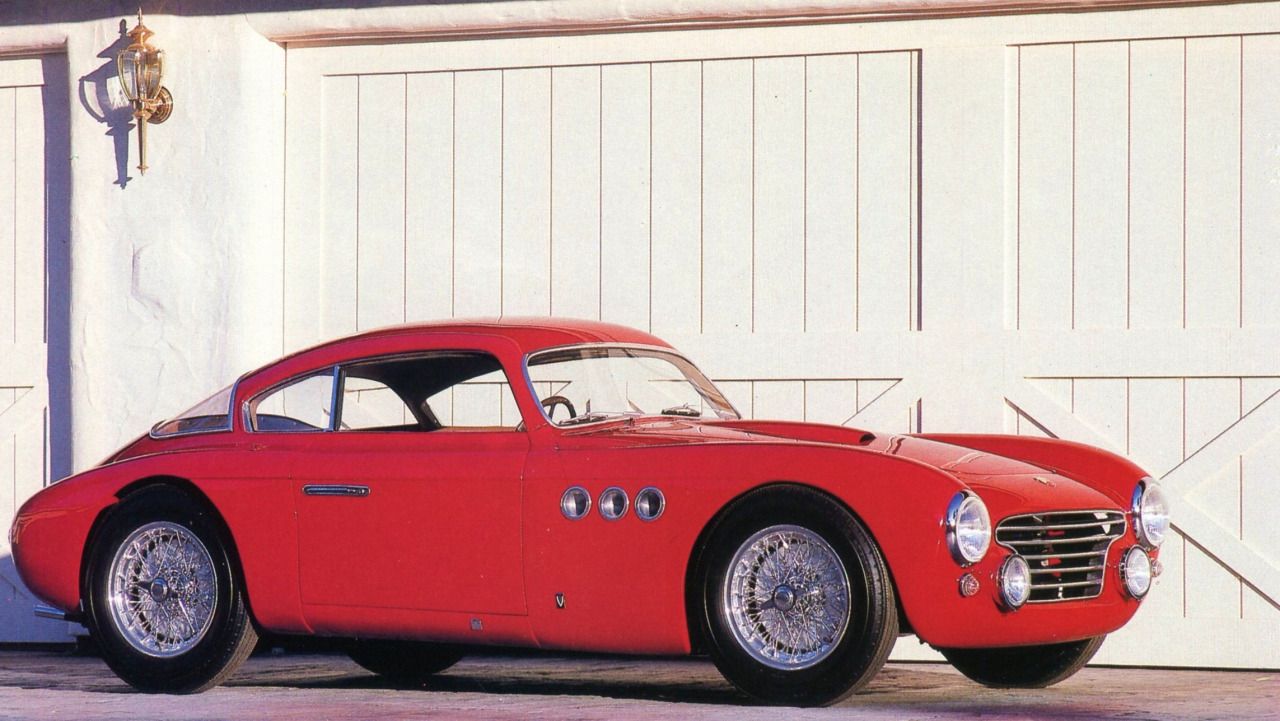
I can’t even remember exactly what it was, like Siata, Moretti, one of those, like a Stanguellini, you know, one of those, like, little Italian marks around in the ’50s and ’60s. I will maybe use this car as a thumbnail because it was such an [00:17:00] awesome little thing. I stood with my son next to it saying this would be the most elegant car in the show, in my opinion, were it bigger.
Isn’t it weird that being big like a Duesenberg is elegant if you carry it off properly, whereas being small like this is always kind of small and is always less? And it’s really weird that size, size is important. Size matters. Well, there is a newsletter, Sports Car Digest I think it’s called. The writer in that highlighted the car in the class next to my little red guy, a blue car with, I thought, the most overstated, silly, filigree design.
Like, all of the gee-gaws that Vignale does, which some of which work, some of which don’t It had all of them and none of them worked on that car. The one next to it, the red one, I loved. Sports car guy dress guy, he had photographed the blue [00:18:00] car with my little red one in the background. Like, my car was…
That was just like cannon fodder in the background. He was commenting on how awesome the blue car was, and that is what’s so special about the Pebble Beach experience. So I mentioned there were the Japanese cars, the rotary Mazdas and, and Toyotas. Well deserved. Fact of the matter is this is the second or third year that I’ve camped at Laguna Seca, and the Group C cars represent one of the very best spectacles.
It’s the shape of them. It’s the noise. Again, it’s the size. They have a presence about them. They’re quite big cars and, you know, my son is there, he’s 12 now, he’s there with two other lads the same age, and they have the same sort of visceral reaction to them. I can’t underline enough how [00:19:00] people at Laguna Seca do not know what it took to win Le Mans in the 1980s.
They don’t know that Martin Brundle won Le Mans in that era. They maybe don’t even know that that orange and green Mazda has a four-rotor engine. But they’re all in that place that I was in reading Motorsport Magazine in the 1980s because there was no Group C on the TV. There was Formula 1 and there was rallying.
There was no Group C on TV, so Group C reached me through reading. You, you just looked at the statistics and you looked at the lap speed and you looked at the top speed and you looked at the pictures of the cars, the still pictures of the cars, and that was enough for me to feel what an incredible spectacle it was.
So what am I saying? I’m saying that the [00:20:00] legend is only growing because people now, youngins, are seeing these cars and then having the same kind of digging back into the past experience that I had reading Motorsport. For them, it’s this looking back through the past. Now, the producer, Eric, the producer, listening in and editing my every word here, you know, he and I have talked about rallying before.
Both of us share a passion for rallying. I, of course, with my following of, of Senna’s career, followed the turbo era in, in Formula 1 and, you know, as I just said, through Motorsport, I, I read about and, and learned about, uh, Group C somewhat as well, or, although less. Eric feels like Group C may well have been the craziest of the three.
I’m not sure. I do think that given they used the Nordschleife Given they used Spa in its current form, not the old circuit, I do feel like, and [00:21:00] given with all of these Group C cars, and this is what I said to people on the lawn at Pebble Beach, is, is, you know, you have to imagine the 240 miles an hour. I gave them the Martin Brundle story.
And then I said to them, look at where your feet are going to be. And Eric, I stole your line from, uh, when we were at Hillsborough, when we worked the Hillsborough Encore together. I stole your line. Look at where your feet are. Your feet are going to be in front of the axle line. And what is there? A bit of fiberglass, bit of tube frame, brake master cylinder, your feet and the barrier if you make any kind of mistake at all.
So that’s not lost on these kids. So the spectacle of Group C is absolutely incredible. And to bring that to the lawn at Pebble Beach and to put it alongside the bat cars, aerodynamic study, the Nardi Blu-ray, the round door Rolls, uh, you know, Century of Progress, Gordon Buehrig, [00:22:00] 20 grand Duesenberg. That row this year along the ocean there told an awesome story in a really interesting way.
It connected cars together in a really interesting way. And of course, as a connoisseur of cars, it’s, it’s great to see the story told in a slightly different way. That’s what I’m saying. Well, what does that have to do with Pebble Beach, you’re thinking. This, dear listener, or one of you that’s stayed with me this long, there were two XJRs on the lawn at Pebble Beach.
Two, not one, two. In keeping with this theme of like royal cars, they had a Lady Diana Spencer one, which brings us onto the other car on the lawn at Pebble Beach, uh, which is the Bob Tullius IMSA or SCCA. It raced in either way a five-speed stick, stripped out, caged XJS, which next to… So there was this SC on the lawn, did I say that, that was built for, [00:23:00] uh, Lady Diana.
She had like a pre-production SC. It also had the American quad headlight nose in it. So that was, uh, was interesting, but it’s like a C or E plater, that kind of, of era if you’re a Brit. That’s the registration plate that it had on it. So the Lady Di XJS and the Bob Tullius SCCA race car that was all kinds of, uh, side piped awesomeness.
It set me surfing people who can turn the Jaguar V12 from a sort of docile pussycat into a Le Mans screaming beast. They are out there, but the engines start at $25,000, which is a little bit more than I was, uh, I was hoping to spend.
Often my favorite car at Pebble Beach is a preservation class car, and thus it was again. This year, uh, there was a Hispano-Suiza [00:24:00] sedan, just like a little sporting sedan. I don’t know what it is about the fact that the same car, had it been restored, would not have been remarkable to me at all. The smell, the paint, the leather The combination of all those things together, this is everything that’s awesome about old cars.
Uh, that car restored is no different to me really than my wife’s nice new Cadillac. The design of it’s different, maybe craftsmanship of the materials is nice, but the unrestored, I’m not gonna say time capsule because that’s such a cliche, but the unrestored, the preserved car that’s now a century or so old, yeah, they are often my favorite car at Pebble Beach each year because [00:25:00] for me, they illustrate what Pebble Beach stands for, which is the preservation and reverence of one’s great design.
So the preservation class Hispano-Suiza, which I, I so loved, had so much more charisma for me than the 20 Grand Duesenberg, which is a car that I know well from the Black Hawks. So I’d looked at that car a lot before, and I, I, I understand why people thought it was exciting at the time if you compare it with other, but it, it just, it just, those kind of jewelry box, Pebble Beach, Black Hawk Collection kind of restorations, they just don’t interest me as much as the car which has come all the way down.
And I don’t know why I wanna keep talking about the smell. When I was with the Hispano, a guy commented to me on how incredible the smell was. It’s a little bit like these, this realization that we’ve had as electrification and its, with [00:26:00] its silence comes, but we really did like the sound of racing cars.
And at Laguna Seca, you know, listening not just to the group C cars, but you know, just to cars racing, there’s, there’s a sense of, you know, we’re worshiping a wall of noise. There’s something to look at, but it’s the wall of noise that is the dominating sensory experience. We sort of didn’t realize that even in the era of the V10s, which Formula 1 cars, which the youngins feel like now is, you know, the greatest era, the screaming V10s.
You know, it was, for sure it was part of the spectacle, but you didn’t feel like it was the dominant sense that you were experiencing the event through. Does that make sense? It’s not a visual experience. It’s, uh, mostly an audible kind of experience because they’re so loud, because you hadn’t expected them to be so [00:27:00] loud, because you can’t quite process the deafening intensity of it.
It is like a heavy metal show, isn’t it? That’s the whole, uh, point of it. So with these older cars, the smell and, and with it then the visual patination that you can see and feel, right? You can feel that the leather’s softer, uh, that the steering wheel’s worn. What am I trying to say? I’m trying to say that smell is perhaps the, the dominant experience with, uh, the patina cars.
My, my final thought would be that as we move towards electrification and we see a generation raised only knowing electrified cars, any kind of gas-powered vehicle is gonna have so much theater about it because it’s gonna have the noise and the smell. And I don’t just mean, you know, the [00:28:00] beautiful Espada Suede interior smell.
I mean the smell of, you know, my diesel F-250 or, or the smell of two-stroke race fuel, which a lot of people will talk about as being, you know, the single most evocative thing in motoring.
So to move from the lawn at Pebble Beach to the week as a whole. If you listen to the piece that Eric and William Ferrari chat Ross did from Kissimmee, we talked a lot there about how, you know, whilst the Bianco Speciale GTO that we’d come to see hadn’t underperformed, it also hadn’t overperformed.
Whereas some of the other cars that we saw, the orange paint sample, Porsche 918, um, or especially the yellow Bachman Ferrari Enzo, these were cars that just did, you know, in the case of the, uh, 918, [00:29:00] $2 or $3 million more than it was valued at. Just stop and think about that. A hell of a lot of money for the auction company to not even see coming.
Hell of a lot of money, right? But this was nothing compared to the Enzo, right? The Enzo was estimated, I think, at like five or eight or something like that, and it got into the teams, like mid-teams. This is, you know, 2X, maybe even 3X what the, the estimate was, what the seller might have realistically expected to get for that car.
So we left Kissimmee being a bit like, “What the fuck’s going on?” And do you remember I did my piece about, oh, the guard’s changing. You know, soon we will see a McLaren F1 overtake a Ferrari GTO in value. Well, Pebble coulda, shoulda, woulda been that weekend because apparently, I’m no a McLaren guru, but my understanding is that there were two short-tailed F95 GTRs or something.
One won Le Mans, the other one went to Nick Mason. It was [00:30:00] painted in pop art, and the Nick Mason pop art car was up for sale, estimated at 35 million, which I thought was, you know, that’s the, uh, less than the white GTO, but only just, and this previous record public auction price for a GTO. So I mean, Dave MacDonald paid in the mid-’70s, we think, but that was a private transaction.
The previous GTO transaction I think was 35. Nick Mason car does not break that 35 number, so we’re not there yet. Something else might need to happen before, you know, McLaren F1s flip Ferrari GTOs as the one to have. “But John,” you’re saying, “what about the Ferrari Luce?” Yeah. What about- The Ferrari Luce.
The guy that bought it made his money in ophthalmic devices, so seeing and bringing [00:31:00] light, it, it works, doesn’t it? He’s also a billionaire and a philanthropist, so he gives a lot of money to charity. So 40 million, rather than just going to a charity, getting this Ferrari in, in return, chassis number 001, I, I can see why he did it.
He’s somebody in the Ferrari world now. If he’s just bought that McLaren F1, what would he have been? Just another rich-guy car collector, whereas by doing this Ferrari Luce, he’s really put himself as somebody in the Ferrari world. Now, I follow a little bit Doug Tabert, that fellow that seems to buy and sell a lot of Porsche GT3s, a main fellow.
He has a podcast called Switch Cars. Uh, he was saying on that apparently Ferraris were the big winners in value for Monterey this year. So if that was the case, this bloke paying $40 million for this Luce, I, I wouldn’t do it, but I can understand why he did, is my point, and I don’t [00:32:00] think it was a waste of money ’cause it went to charity, right?
The car itself, they did have one there. I mean, it does have slightly more elegant proportions than the Nissan Leaf, which, you know, the internet has been comparing it to, but it definitely looks like a mouse, right? It… When they tell you the guy from Apple designed it, you’re like, “Oh, yeah.” I mean, they had one on the lawn at Casa Ferrari right alongside the Ferraris of, of the past.
And, uh, not only, not only is it not a narc Daytona, which I don’t know if you can picture what animals they are, but not only is it not that kind of aggressive shape, it’s not got the prettiness of a 206. It’s not got the look at my big dick of a Testarossa. Doesn’t have any of, of that going on. Now I know, right?
It’s [00:33:00] aimed at a different demographic, and it’s a glib to say that, but I think the statistic that you need to think about with the Luce is that less than 1% of the people wealthy enough to own a Ferrari have owned a Ferrari. Do you think the same stat is true for a Mercedes-Benz? I put it to you, absolutely not.
So Ferrari can achieve a great deal more market penetration, can’t they, without diluting the brand’s exclusivity at all, right? That seems to be the thought, and the thought seems to be that if Porsche can basically be building SUVs and four doors now, but can still have an image as a sports car maker and can still churn out, you know, the odd Boxster and GT3 RS, then how’s an Porsche continue to be what Porsche always [00:34:00] were?
And f- you know, Ferrari are a publicly traded company. They have to make money, and making money means selling more cars, and there’s tons of demand for the cars in different parts of the world, but those people are not gonna buy Testarossas. And in today’s day and age, how can you even make something as cool as a Testarossa?
Uh, whether it’s the ’50s thing or the ’80s thing, right, you just can’t make those kind of, of vehicles now. Y- you know, from a legislation perspective, you simply can’t build those kind of vehicles now. So I see that Ferrari had to do something different. Although the notion of partnering with Apple, ’cause I don’t like Apple myself, partnering with Apple as, you know, they do the best technology.
We’re living in an age of technology. How can we marry ourselves to… I see the rationale of all of that, and I don’t hate it because it is so different that it’s left room for them still to do really pure stuff. [00:35:00] So I’ve made my peace with the Luce is, uh, is I guess what I’m saying.
So the record number, 760 million or whatever for Pebble Week, that record number is carried by a small number of cars at the very top of the market. It’s the K-shaped economy, right? Now, what that looks like on the ground at Pebble is more and more events, Tutto Bene, an Aston Martin exclusive party.
Ollie trying to get into the Jaguar stand only to find, you know, you had to be an invited Jaguar VIP to get onto the Jaguar stand. So there’s more of that kind of, you know, late model people coming to Car Week, but the kind of people who I don’t know, I, I sat in a three-star restaurant with my wife the other day.
It was, like, a couple of months ago. It was a date. A tasting menu, two tech [00:36:00] bros in their 30s sat next to us, and they were, like, having a, like, a let’s catch up. But, you know, they were having this m- m- tasting menu that was definitely costing more than $500 ’cause they had the wine pairing as, as well, right?
So, you know, they’re the same thing as we had, and, and, you know, I know what the bill was. So I sat there thinking, trying not to listen to the conversation, focus on my wife. But, you know, y- you always, uh… ‘Cause afterwards my wife and I talked, right? And she was like, “Yeah, I was trying not to as well,” but you’re sort of trying to listen as well.
And I knew when my wife went to the loo, I vaguely tuned into their conversation, and I thought, “I bet you they’re gonna talk about Porsches at some point.” And, uh, sure enough, I, I would say not 10 minutes later, they had a conversation about, “You’ve got your GT3, um, RS has come,” that kind of, of thing. You know, you shouldn’t be put off a car because of the kind of people who own it, should you?
You know? You shouldn’t be put off the performance bargain that C4 Corvettes [00:37:00] are because they have the image that they have. You shouldn’t be But, oof, it can be hard. But look, right, the tech bros with their GT3s, that is the K shape. It’s people who are further up that curve who are driving the values of F40s, of F1s.
I also think it’s part of the generational wealth shift that you read about on the, you know, financial… I was gonna say pages of the newspaper, but you know, you know what I mean. Like, the financial. In your financial scrolling, you will come across people talking about, you know, the great wealth transfer as the boomers’ generation passes, right?
Well, I had heard that a couple of the top wealth management firms, so firms that look after the money of the billionaires and the hundreds of millionaires, these fellows [00:38:00] have begun to allow inclusion of cars, certain cars, if you’re on the list. If your name’s not on the list, you’re not coming in.
Certain cars alongside art. So just as in a diversified portfolio you would have stocks, and shares, and property, you might have art, a small proportion allocated to. And now cars, certain cars, blue-chip collectibles, you know, 300SLs, Ferrari F40s are on that list. Now, I’m not sure if 300SLs are on the list, right?
Because that is last generation stuff. I’m sure the F40 is. I’m sure the 959 is. You know, I’m sure. So that’s the kind of stuff that is truly investment grade, right? Literally investment grade now. So apparently this is what’s driving the, the, the price boom. So the flip of that is what, what are the bargains out there?
[00:39:00] Well, the statistics are that, you know, muscle stuff, ’50s stuff, muscle stuff’s kind of flat and, you know, ’50s stuff, ’30s stuff is really going down a little bit. And I’ve heard two or three people say that. Uh, you see that in… You know, one of the other Pebble Dosens was talking about trying to get rid of a couple of ’20s cars that he’s got and, you know, there’s just no interest in them.
And you, you sit there thinking, you know, if you were gonna get this kind of car, this is the bloke to get it from But I just don’t care about Model T Fords, you know? I d- y- I mean, it is faintly interesting, but they’re just so hard to use because of that low top speed. And, you know, if you’ve got your own estate to drive around, maybe.
But, I mean, yeah, they’re just not practical, and I’ve got too much stuff that’s not practical already. So I mentioned that we were out at the track. There was a e- exhibit of Japanese [00:40:00] motorsport heritage, Formula 1 cars, but also a great collection of bikes. So I was, uh, you know, looking closely at Nicky Hayden’s RCV211 and there was a Mick Doohan two-stroke guy there.
And, and so I was focused on that when I noticed Kenny Roberts and Eddie Lawson just there chatting. Being me, I didn’t be like, “Ooh, can I have an, uh, autograph?” Didn’t do that. Stood, like, respectfully, uh, off. They were chatting with another guy, and he was asking them a lot of questions, and they were asking him about the nice Honda CB750 that he had, who I did not recognize.
I recognized him, but couldn’t place his name. Well, later I realized it was Jim Farley, CEO of Ford. So there’s Farley, Kenny Roberts, King Kenny Roberts, the guy that popularized the knee-down slide, foil to Barry Sheene, and Eddie Lawson, [00:41:00] who’s known for those big Kawasakis, who was like a MotoGP champion.
So this is the era where the two-stroke Grand Prix bikes produced such pr- made the power so brutally that the only people who were able to ride them were people who’d grown up riding two-stroke dirt bikes. So all the, like, smooth European guys, hopeless. The guys that just rode it on the back wheel, and when it broke away, they just bloody caught it, those guys, they were the fast guys.
So Lawson was, was one of those. Um, others were like Randy Mamola. Also saw Wayne Rainey, and Wayne Rainey, you know, had a sort of Senna-Prost kind of rivalry with Kevin Schwantz in the, in the early ’90s, contemporary with Prost and Senna in a super cool way, riding these super cool two-stroke bikes. Um, unfortunately, if you don’t know the story, Rainey had a fall, was paralyzed and, you know, was in the wheelchair when he was chatting there with, uh, with Jim Farley and Eddie Lawson and King Kenny.
Now, that would be a cool [00:42:00] story in itself, wouldn’t it? But as I’m stood there, Farley asks Lawson “Did you ever ride that?” And he’s pointing at a flat track Yamaha XS, but it’s not like a 650 with two cylinders, which is, uh, you know, like 100 mile an hour bike. It’s a four cylinder. And if you don’t know flat track, flat track is an oval.
Uh, some of them a mile, some of them half miles, but it was popular years ago. And it’s kind of like speedway, in the English sort of speedway, but on bigger tracks, where you’re fast on the straight, and then you just lean the bike over in a slide. You have like a metal shoe, and you’re gonna drag the inside foot on the dirt there as the back of the bike slides.
If, if it sounds terrifying and dangerous, you, you’re absolutely right. There is a movie called On Any Sunday. If you’ve not seen it, it’s an absolute must-watch. It’s all about motorcycling, but it’s [00:43:00] also specifically about flat track, and the opening credits feature flat track riders. “Did you ever ride that bike?”
Farley asks Lawson. Lawson grimaces and says, “Too fucking dangerous for me.” So I carry that thought back to camp, because back at camp is one of my mates whose dad raced flat track, whose dad not only raced flat track, but appears in the credits of On Any Sunday, in the opening credits, crashing, no less.
Not just in the credits doing flat track, but in the credits crashing. Bloke’s still alive now. So I get back to camp. I tell Jason the story I just recounted to you. So Jason’s like, “Oh, I’ll ask my dad if he ever rode any of the four-cylinder ones.” Back comes the reply, “There were four-cylinder Hondas as well.”
“Did you ever ride them?” asks Jason. “I’m still alive, aren’t I?” comes the reply. Thank you. Drive through.[00:44:00]
This episode has been brought to you by Grand Touring Motorsports as part of our Motoring Podcast Network. For more episodes like this, tune in each week for more exciting and educational content from organizations like The Exotic Car Marketplace, The Motoring Historian, Brake Fix, and many others. If you’d like to support Grand Touring Motorsports and the Motoring Podcast Network, sign up for one of our many sponsorship tiers at www.patreon.com/gtmotorsports.
Please note that the content, opinions, and materials presented and expressed in this episode are those of its creator, and this episode has been published with their consent. If you have any inquiries about this program, please contact the creators of this episode via email or social media as mentioned in the [00:45:00] episode.
Highlights
Skip ahead if you must… Here’s the highlights from this episode you might be most interested in and their corresponding time stamps.
- 00:00 Pebble Beach Recap Begins
- 00:58 Best in Show Duesenberg SSJ
- 10:18 Gotham City Streamliners
- 16:36 Vignale Oddities and Taste
- 18:16 Group C Magic at Laguna
- 22:26 Two XJS Surprises
- 23:49 Preservation Class and Patina
- 28:18 Auctions and Market Shock
- 30:41 Ferrari Luce and Brand Future
- 35:07 K Shaped Car Economy
- 39:52 Moto Legends Trackside
- 43:58 Wrap Up and Credits

Enjoy more Motoring Historian Podcast Episodes!
The Motoring Historian is produced and sponsored by The Motoring Podcast Network