
The Motoring Historian, Jon Summers, travels through rural Oklahoma west of Oklahoma City while reflecting on the centenary of Route 66, designated in 1926 from Chicago and St. Louis to Santa Monica/Los Angeles. Driving on I-40 with old Route 66 running nearby, he describes surviving original stretches, the road’s many museums and roadside ephemera, and why so many buildings and towns along it declined after freeways bypassed them and as vehicles became more reliable, reducing the need for frequent service stops. He connects Route 66 mythology to pop culture like Pixar’s Cars, murals of 1960s–70s muscle cars, and a TV-era romance of cross-country travel tied to Hollywood dreams. He also notes evolving freeway infrastructure, a Tulsa routing mistake, and mixed feelings about Route 66 icons like Cadillac Ranch and its imitators.
Be sure and also revisit Jon’s previous episode(s) on Route 66, EP11: Cricket, Poker, Gold, Route 66 Revisited and Death Valley with no A/C: and more importantly EP4: Route 66, Roadtrips and the Third Wall (tune in below):
Notes
Jon Summers is the Motoring Historian. He was a company car thrashing technology sales rep that turned into a fairly inept sports bike rider. On his show he gets together with various co-hosts to talk about new and old cars, driving, motorbikes, motor racing, motoring travel.
- The predecessor: the Lincoln Highway
- How much of Route 66 survives ? Lots
- Radiator Springs and the Cars movie
- The proliferation of Route 66 Museums
- Pisarro and MissouriMurals on Route 66; perfect portraits of muscle cars
- The Spirit of Route 66 is wedded to certain cars, a certain era
- Route 66 Fifties TV Show
- Cadillac Ranch
Transcript
[00:00:00] John Summers is the motoring historian. He was a company car thrashing technology sales rep that turned into a fairly inept sports bike rider. Hailing from California, he collects cars and bikes built with plenty of cheap and fast and not much reliable. On his show, he gets together with various co-hosts to talk about new and old cars, driving, motorbikes, motor racing, and motoring travel.
Good day, good morning, good afternoon. It is John Summers, the motoring historian, and again, I am on the road, this time rural Oklahoma, west of Oklahoma City. The bit where it starts to feel like plains and then like Texas instead of all nice rolling green hills and bucolic [00:01:00] ponds, which Missouri is like, and a lot of Oklahoma is like that.
I really must explore that area more. But I digress. So I’m on Route 66, aren’t I? Theme of this episode is Route 66. Everyone’s talking about Route 66 because it’s the centenary of Route 66. What is Route 66? I mean, you probably know this, but it was a route designation, right? The highways agency at the time wanted to help people drive from one place to another, so they called roads things like Route 66 or earlier, the cross-country route was the Lincoln Highway, San Francisco to Times Square in New York.
Route 66, of course, is Midwest, like Chicago, St. Louis, and then to Santa Monica, Los Angeles. [00:02:00] Route 66 was a designation that was given in 1926, hence this being the centenary of it. What is there left? Well, the answer is, for as long as I’ve been talking to you, I’ve been running on 40 with the cruise set at a legal 75, and to my right there is Route 66.
It’s about 50, uh, oh, no, less than that. I would say at most 100 feet, probably only 50 feet from the road that I’m driving on now. It’s a two-laner, but the surface is the original surface. Original to 1926. You say, “Well, Matt.” Because obviously, right, the route changes shape over time. One of the tropes of Route 66 is the town which is bypassed by the road, bypassed where the main road, the freeway, Highway 40 that [00:03:00] I’m on, bypassed by the road, the town dies.
And of course, this story, this trope, is best expressed through the Pixar Cars movie that, you know, at one time 10, 15 years ago was really one of those, like Mickey Mouse, Coca-Cola, Harry Potter ubiquitously recognized. I think less so now based upon conversations with my students who are early 20s, late teens.
But yeah, that might just be my students. It might reflect my students’ international background. Either way, certainly with Queen and the Pixar franchise, the Pixar Cars movie franchise depicts this town, Radiator Springs, and so much of the imagery of the Cars movie is drawn from different parts of Route 66 mythology.
Well, what is this Route 66 mythology. What do I mean by that? I mean [00:04:00] that, yes, there’s the physical road there, and you can drive on it, but Route 66 is a whole lot more than that. Yes, John, there’s museums, and there’s all these silly world’s largest rocking horse and world’s largest clogs m- things to go and look at for the tourists now.
Yes, yes, there is. And, and almost every exit where it says Route 66, there’s a Route 66 museum. I, I mean to stop and go in one day and actually see what they’ve got and, you know, go deeper with the ephemera of what Route 66 is because a road that has a museum, not one museum, but lots of museums… Like, what would you put in a museum to the M5 motorway in England?
You know, I don’t know, like, a man with receding hair and a company car that has too many miles on it? I don’t know. How would you, you de- depict that? But of course, that’s not what these kind of museums are. They are full of the [00:05:00] stuff that was by the side of the road to service people who were driving on Route 66.
And then one of the things that I think’s noticeable is in the old days, the cars were crap. You needed to stop a lot. It wasn’t just that the roads go past the towns now, it’s that cars used to really need gassing up pretty often. They used to need serious work, not uncommonly. So in other words, if the weather was damp, I could see my 1980s Ford Cortina not starting.
I could easily see you driving out to a place like this, going to bed outside the motel, coming out, and your muscle era Ford, if it was anything like my ’80s Cortinas, Sierras, that kind of thing, not starting because it was damp. The point I’m making here is that even comparatively recently, the ’70s, the ’80s, there was a lot more need for [00:06:00] roadside service, roadside repair.
Nowadays, you might be able to drive 100 miles between giant Love’s truck stops. In the old days, you couldn’t do that because vehicles would break down between that distance, so it would make sense for there to be service stations at far more frequent intersections. So the reason why there are so many dead buildings along Route 66 is because the distances cars and trucks can drive and the amount of service they need has progressively gotten to be less.
I hope that makes sense So there are the physical manifestations left, the road itself, which you can drive on, which is an incredible, incredible thing that you can do it for thousands of miles literally from here in Oklahoma through New Mexico into California, the road runs parallel. Now, [00:07:00] typically, and this is not surprising, the road is like a frontage road now.
So when you get into a town, there’s shops and businesses that have grown up along Route 66. Let’s get out of this Ram fellow’s way. There we go
It’s like bucolic. I just passed… There’s a tree with black cows all sheltering from the monster heat underneath it. But it looks like, it looks like the kind of scene that could have been painted by Pizarro or one of those French landscape painters where you can actually see what they painted. They didn’t just paint lilies in their back garden.
Well, why don’t you drive on Route 66, you’re probably saying. Well, the answer is I did on the way here, and it took me ages, and I just need to cannonball a bit more right now. But is that losing the essence of Route 66? Well, I was thinking it might be. But here’s the thing, if you cannonball [00:08:00] like this, you actually see the country change.
And here’s the other thing, part of what Route 66 represents, I think, is a joined-up America, an America which is accessible. And therefore, driving on this road where you just set the cruise, you know, do whatever you like with your mind as you just drift down the highway here, this is America connected, isn’t it, with this kind of, of highway?
The whole notion of the modern American highway is wrapped up with Route 66 On the way across, I shot film and sort of talked as well about how the Route 66 murals and things that you see, it’s sort of from a particular time. So I was struck by one mural that featured a perfect Marina Blue [00:09:00] 70 Chevelle SS.
And, you know, it was on rally wheels. It was perfectly depicted on a mural in one town. And in another town nearby, when I was rolling, you know, on the way over here, there was this perfect 65, 64 and a half Mustang convertible in white, roof down. You know, you could see the VA emblem on the fender. I did as I rode past.
So again, it’s this notion that while the concept of what Route 66 might be is vague, we can nail it to this kind of car, this make model even. Well, that’s really interesting, isn’t it? Well, also those are from the 60s and the 70s, right, aren’t they? So is that when the myth of Route 66 was there? Maybe when [00:10:00] you read much about Route 66, they often talk about a show.
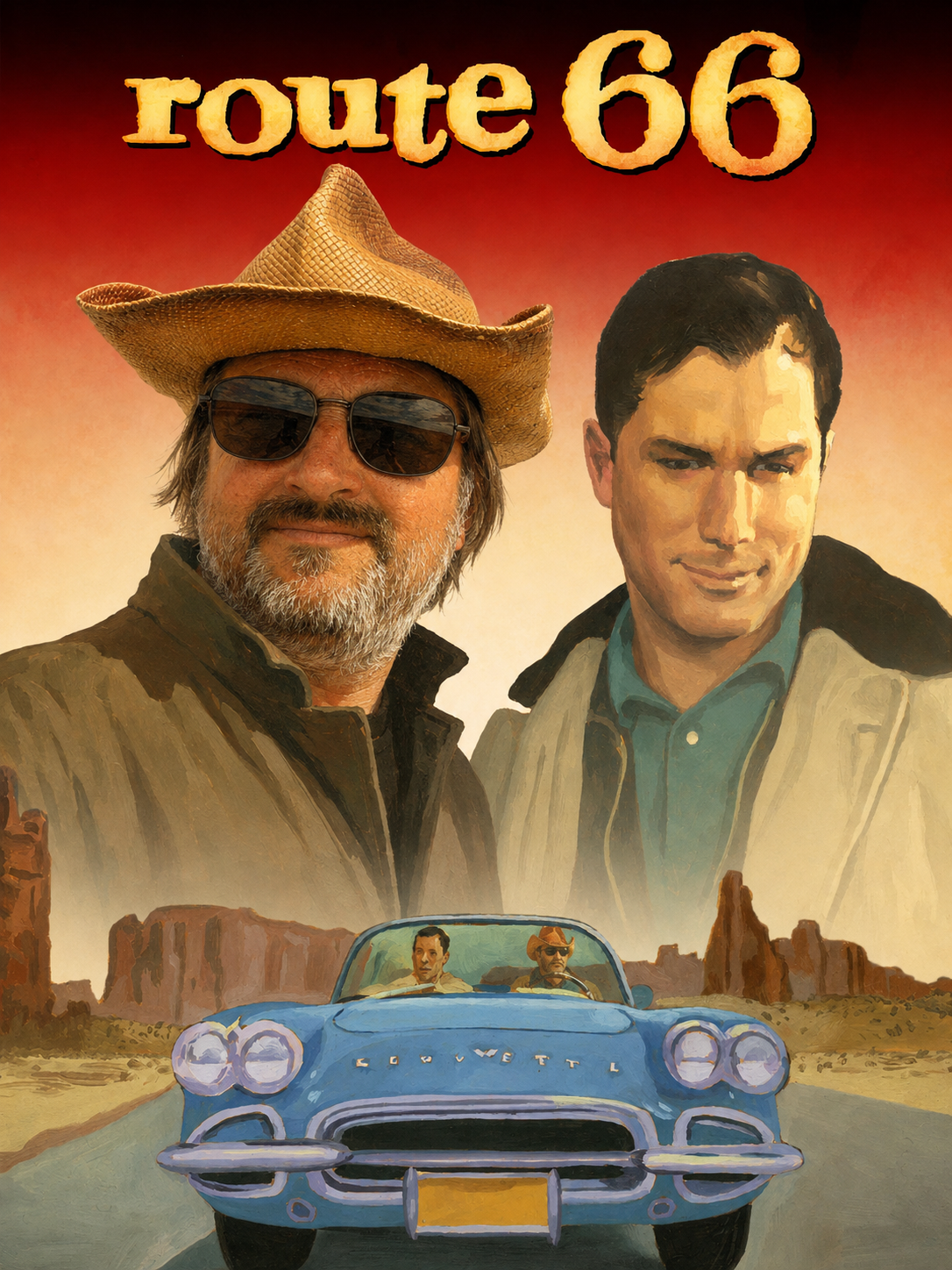
I don’t know if I remember if the show was called Route 66, but fundamentally it featured the sort of spirit of Route 66. And it was these two guys in a Corvette traveling around having adventure. A bit absurd if you think about it, because a Corvette’s a terrible car to be traveling around in from place to place, a 50s Corvette.
But it captured the romance of the road for a certain generation of Americans. And Route 66 is close to that.
So to drive that older road
is to wonder at what point in time you are stepping back to. What, what do you mean by that? Well, the idea of Route 66, I think, is [00:11:00] tied in the era of those cars, the Mustang, the Chevelle, that this is the ’60s, ’70s. This is the era where all of the entertainment and movies came from Hollywood, and the rest of America culturally looked to Hollywood.
You know, if you wanna make it big, you got on the Greyhound bus, and you went to Hollywood to make it big kind of thing. This, this is the myth of how it worked, right? Well, if that was the myth of how it worked, Route 66 was the mythical road that you were gonna get on to get there. So let’s clarify that a little bit more.
The magic of the road, the reason why there’s all the museums, the mythology of the road, is all wrapped up, I believe, with the dreams that people had of going to Hollywood and making it as a movie star or as a [00:12:00] actor, entertainer. What the dreams the everyday Americans had could be realized by going on Route 66 to Hollywood and achieving fame and wealth and glamour.
Now let’s just think about that idea of towns being bypassed. What does that look like? It looks like somebody recognizing that there’s a section of road that’s not very well-serviced if people have breakdowns, and so they open a, a gas station or a tire place or a free radiator water and clean bathrooms kind of place.
They just open something that services motorists And if that business is successful, other businesses spring up nearby and [00:13:00] communities grow up around that. So some of these places that you drive through on Route 66, I mean, they have schools, maybe only, you know, open from like the 20s to the 60s or something like that, but they had schools.
Now, what I think is interesting about this is there are ghost towns in Nevada that, you know, look like complete Western towns and then 20 years later are completely gone. By complete Western towns, I mean, you know, there’s wooden buildings on both sides of the streets like you see in cowboy movies and loads of people walking around and, you know, horses tied up and saloons and that kind, you know, a bustling community.
Well, even the wood goes in Nevada because it doesn’t rot. So you can just take your buildings down and put them up somewhere else. So that’s what people do, believe it or not. So this notion of community that comes into existence exists for a decade or two, [00:14:00] walking and talking like a community which you as a European or an East Coaster might recognize and then just completely evaporating like some sort of weird tent city burning man meets the Wild West.
That seems to be a reality for a lot of these communities. So let’s go back to these towns. Let’s go back to one of these towns. First the tire place, first just the tire place. Now the gas station. Now the shop. Now the antique shop. Now the used car salesman. Now the diesel truck service. So now there’s a lot of people going backwards and forwards across the road and there’s an accident.
So they put in a stoplight. It’s great, right? It makes people stop and look around and need to get traffic, right? Now the stoplight is a pitch point, isn’t it? Especially if because of the stoplight, more people are stopping and [00:15:00] getting out and buying their Indian souvenirs and their Coca-Colas and decided to stay in the themed motel that they’re looking at.
Given all of that, it’s pretty easy to see why a decision might be taken to bypass that town. So you have the Radiator Springs scenario where the town, once so bustling because of the road, now is bypassed and falls into decline.
So it’s still out there running parallel now. And there are tumbled down buildings regularly. But what I would say is most of it is completely untraveled. And in all the time that, you know, I’ve spoken to
you since we’ve been driving here, there has been no traffic on Route 66. So if you yourself choose to [00:16:00] drive it, you have a weird experience because was it this quiet years ago? No, because that’s why they built the main highway. But how well-traveled was it in 1928 in comparison to 1968? How much of 40 was actually built in 1968?
By that I mean that you could look up individual sections, but the route is always evolving. I drove the wrong way coming through Tulsa. This is coming in the other direction, coming east through Tulsa. Just because of the way the freeways were laid out, I’d not done it before, I just found myself in the wrong lane, fast-moving, heavy traffic.
It just took me the, the wrong way. This happens, doesn’t it, in, in, in Europe, but quite often what they’ll do at junctions like that is they’ll redesign them to make it better. And coming through the other way today, I realized that that’s [00:17:00] exactly what they’re doing, that they’re doing a whole building project which is gonna move away from that kind of ’50s looking freeway infrastructure to something that looks like it was, uh, you know, built to cope with the 21st century
First blew by Cadillac Ranch. I did stop there the first time I came across the country. Actually recognized the hotel where I stayed and ordered the worst, slowest takeaway pizza I’ve ever had. I actually recognized that magenta on the way here through Amarillo. Cadillac Ranch, you’ve seen it, the graffitied Cadillacs in the ground.
A Route 66 icon, they’ll say. You have to stop. I mean, maybe. They’re a long way from the freeway, so rather than looking impressive, they look a bit forlorn, and it’s quite easy to miss them, [00:18:00] especially if you’re going west. Now, when I went, it was early in the morning, 7:30 in the morning, and I had them to myself.
It was raining, so you couldn’t really see them properly. But, you know, I, I had a experience. What I was trying to say? I, I’m… Am I trying to say I had an authentic experience that, you know, if you go with all… No, I’m not trying to say that. I’m trying to say that now, on the way into Amarillo, coming, if you’re coming west, there’s Volkswagens graffitied in the ground in the same way, and before you get to Cadillac Ranch, there is a RV park that has nicely painted Cadillacs, but with their fins in the air.
I have a feeling they were fiberglass replicas. But why is something not cool if it’s, like, done to death? I feel like that was a cool thing when it was just [00:19:00] ironic artwork. Well, not ironic. I don’t know what it was. When it was like an art installation that you could interact with, that was a deeply cool thing.
When other people copied it, I don’t know, that really seems to dilute the cool. Thank you, drive through.
This episode has been brought to you by Grand Touring Motorsports as part of our Motoring Podcast Network. For more episodes like this, tune in each week for more exciting and educational content from organizations like The Exotic Car Marketplace, The Motoring Historian, Brake Fix, and many others. If you’d like to support Grand Touring Motorsports and the Motoring Podcast Network, sign up for one of our many sponsorship tiers at www.patreon.com/gtmotorsports.
Please note that the content, opinions, and materials presented and expressed in this episode are those of its creator, [00:20:00] and this episode has been published with their consent. If you have any inquiries about this program, please contact the creators of this episode via email or social media as mentioned in the episode.
Highlights
Skip ahead if you must… Here’s the highlights from this episode you might be most interested in and their corresponding time stamps.
- 00:00 Rolling Into Oklahoma
- 01:11 Route 66 Explained
- 02:08 The Road Still Exists
- 03:53 Museums and Roadside Life
- 05:07 Why Towns Died Off
- 07:42 Cannonballing, Murals Cars, and Romance
- 10:54 Hollywood Dreams Myth
- 12:23 How Bypasses Kill Towns
- 17:20 Cadillac Ranch And Copycats
- 19:28 Network Credits And Outro
Enjoy more Motoring Historian Podcast Episodes!
The Motoring Historian is produced and sponsored by The Motoring Podcast Network